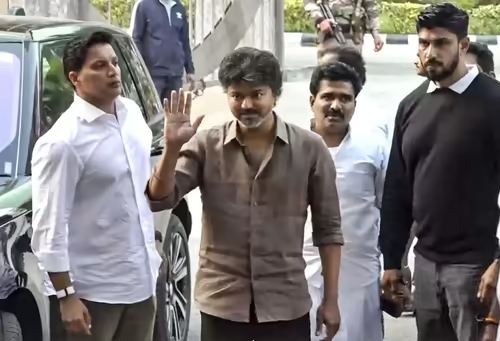
The tragic Karur stampede case continues to send shockwaves through Tamil Nadu’s political and administrative corridors. On January 18, 2026, the Central Bureau of Investigation (CBI) summoned Tamilaga Vetri Kazhagam (TVK) founder and actor-turned-politician Vijay for a second round of intense questioning—a marathon six-hour session that has raised fresh questions about his party’s involvement in the ill-fated public event that claimed 12 lives .
This development marks a significant escalation in the probe, as investigators zero in on the chain of command, permissions, and crowd management protocols surrounding the gathering in Karur district. With public outrage mounting and demands for accountability growing louder, the CBI’s scrutiny of Vijay—the face and leader of TVK—has become a pivotal moment in the case.
Table of Contents
- What Happened in Karur?
- Why Was Vijay Called by the CBI?
- Key Questions Posed During the 6-Hour Grilling
- TVK’s Response and Public Reaction
- Broader Implications for Public Event Safety
- Conclusion: What’s Next in the Investigation?
- Sources
What Happened in Karur?
On January 14, 2026, a massive public meeting organized by TVK in Karur turned catastrophic when a sudden surge in the crowd near the exit led to a fatal stampede. The event, held to mark the party’s foundation day, drew tens of thousands of supporters. Poor crowd control, inadequate emergency exits, and a lack of coordination with local authorities were cited as immediate causes of the disaster .
Twelve people—mostly women and elderly attendees—lost their lives, and over 30 others were injured. The incident triggered widespread condemnation and prompted the Tamil Nadu government to hand over the investigation to the CBI within 48 hours, citing the need for an impartial and thorough probe .
Why Was Vijay Called by the CBI?
As the founder and president of TVK, Vijay is ultimately responsible for all party activities, including large-scale public events. While he was not physically present at the Karur venue, the CBI is examining whether he approved the event plan, sanctioned the budget, or was aware of the logistical shortcomings that led to the tragedy.
His first round of questioning occurred on January 16, but new evidence—including internal communications and permit applications—prompted investigators to call him back for a more detailed session. This second interrogation, held at the CBI’s Chennai office, lasted from 10 a.m. to 4 p.m., underscoring the seriousness of the inquiry .
Key Questions Posed During the 6-Hour Grilling
According to sources familiar with the investigation, the CBI’s line of questioning centered on several critical areas:
- Event Authorization: Did Vijay personally approve the Karur event? Who in his inner circle gave the final go-ahead?
- Security & Crowd Management: Was a professional security agency hired? Were police or disaster management officials consulted beforehand?
- Permit Compliance: Were proper municipal and district-level permissions obtained? If not, who decided to proceed anyway?
- Communication Records: Investigators examined Vijay’s phone and email logs for any messages related to the event’s planning or risk assessment.
- Financial Oversight: How was the event funded, and who controlled the expenditure for logistics and infrastructure?
Notably, the CBI is also probing whether there was any pressure from local officials to downplay safety concerns in the days leading up to the event—a potential angle that could widen the scope of the investigation beyond TVK itself .
TVK’s Response and Public Reaction
TVK has maintained that the tragedy was an unforeseeable accident and expressed deep condolences to the victims’ families. In a statement, the party said Vijay “fully cooperated” with the CBI and is “committed to transparency.” However, critics argue that as a political leader organizing mass rallies, Vijay bears moral and organizational responsibility—even if he wasn’t on-site .
Public sentiment remains divided. While loyal supporters defend him, opposition parties and civil society groups are demanding stricter accountability for political figures who host large gatherings without adequate safety measures. Social media has been flooded with calls for legal action, not just against ground-level organizers but also top leadership.
Broader Implications for Public Event Safety
The Karur stampede case has reignited a national debate on the regulation of political and religious gatherings in India. According to the National Disaster Management Authority (NDMA), over 70% of stampedes in the past decade occurred at unregulated or poorly managed public events .
Experts are now urging state governments to enforce mandatory safety audits, crowd simulation models, and real-time monitoring systems for any event expecting more than 5,000 attendees. The Karur tragedy may well become a catalyst for nationwide reforms in public assembly protocols—something that could prevent future loss of life.
Conclusion: What’s Next in the Investigation?
As the CBI continues its meticulous probe into the Karur stampede case, all eyes are on whether charges will be filed against senior TVK officials—or even Vijay himself—for criminal negligence or culpable homicide. The agency is expected to submit its preliminary report by early February 2026.
Beyond legal consequences, this case serves as a stark reminder that political ambition must never override public safety. For a nation that regularly hosts massive rallies, festivals, and processions, the lessons from Karur cannot be ignored. To understand how other countries manage large crowds, see our analysis on [INTERNAL_LINK:crowd-control-best-practices-global].
Sources
- “Karur stampede case: CBI quizzes Vijay for 6 hours in 2nd round,” Times of India.
- “12 dead in Karur stampede during TVK event,” The Hindu.
- “TN govt hands over Karur stampede probe to CBI,” Indian Express.
- “Vijay questioned again by CBI in Karur stampede case,” Deccan Chronicle.
- “CBI probes possible official collusion in Karur event,” News18.
- “TVK releases statement on Karur tragedy,” DT Next.
- “Guidelines for Crowd Management in Public Events,” National Disaster Management Authority (NDMA), Government of India.