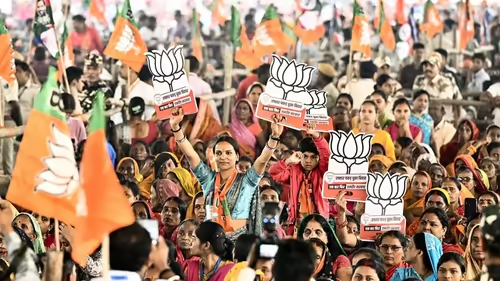
How BJP Is Squeezing Regional Parties Out of Indian Politics: A Strategic Breakdown
For decades, India’s federal democracy thrived on a vibrant ecosystem of regional parties—powerful local forces that shaped national coalitions and guarded state interests. But today, that ecosystem is under unprecedented pressure. The Bharatiya Janata Party (BJP) isn’t just winning elections; it’s executing a multi-pronged strategy to shrink the very space in which BJP regional parties once flourished. The result? A dramatic centralization of political power and a weakening of India’s traditional federal balance .
From Maharashtra to Bihar to Uttar Pradesh, recent electoral outcomes reveal a clear pattern: regional players are either being absorbed, fragmented, or rendered irrelevant. This isn’t accidental—it’s engineered.
Table of Contents
- The Three Pillars of BJP’s Squeeze Strategy
- Case Studies: Maharashtra, Bihar, and UP
- Welfare Schemes as Political Tools
- Narrative Control and Media Dominance
- Can Regional Parties Fight Back?
- Conclusion: The Future of Indian Federalism
- Sources
The Three Pillars of BJP’s Squeeze Strategy
The BJP’s campaign against regional dominance rests on three interconnected tactics:
- Fragmentation: Encouraging splits within regional parties or backing breakaway factions to dilute their vote share.
- Welfare Co-option: Launching direct-benefit transfer schemes that bypass state governments, making voters feel personally indebted to the Centre.
- Narrative Hegemony: Controlling the national discourse through media, social platforms, and cultural messaging to frame regional leaders as “anti-national” or “corrupt.”
This trifecta has proven devastatingly effective—even in states where the BJP lacks deep historical roots.
Case Studies: Maharashtra, Bihar, and UP
Maharashtra: Once dominated by the Shiv Sena and NCP, the state saw both parties fracture. The BJP capitalized by aligning with Eknath Shinde’s rebel Shiv Sena faction and Ajit Pawar’s NCP splinter group—effectively turning rivals into junior partners .
Bihar: Despite Nitish Kumar’s repeated attempts to stay independent, the BJP’s alliance with his JD(U) has steadily eroded his autonomy. Meanwhile, Tejashwi Yadav’s RJD remains confined to opposition status, unable to break the BJP-led coalition’s grip.
Uttar Pradesh: The Samajwadi Party and BSP, once giants, have been reduced to shadows. The BJP’s consolidation of upper-caste, OBC, and non-Yadav Dalit votes—combined with aggressive welfare outreach—has left Akhilesh Yadav and Mayawati struggling to regain relevance .
Welfare Schemes as Political Tools
Programs like PM-Kisan, Ujjwala Yojana, and PM Awas Yojana aren’t just policy initiatives—they’re political instruments. By delivering cash, gas cylinders, and housing directly to beneficiaries, the BJP ensures that credit flows to Prime Minister Narendra Modi, not state CMs.
This “Modi-centric welfare model” bypasses regional parties entirely. As one Election Commission report noted, over 70% of rural beneficiaries associate these schemes with the PM personally—not their local MLA or CM . This erodes the traditional patronage networks that regional parties relied on for decades.
Narrative Control and Media Dominance
Beyond policy, the BJP excels at controlling the story. Through a mix of friendly media houses, social media armies, and strategic messaging, it frames any resistance to its agenda as “anti-development” or “anti-national.”
Regional leaders like Mamata Banerjee or M.K. Stalin are often portrayed not as legitimate dissenters, but as obstacles to progress. This national narrative drowns out local voices, making it harder for regional parties to build pan-India credibility or even defend their state-level mandates.
Can Regional Parties Fight Back?
Yes—but only if they adapt. Survival requires:
- Stronger state-level governance to prove they can deliver better than the Centre.
- Coalition-building across regions (e.g., INDIA bloc) to counter BJP’s national machinery.
- Digital storytelling to reclaim narrative control from centralized media.
However, as long as voters equate development with Modi and welfare with the BJP, the squeeze will continue. For more on India’s evolving party system, see our analysis on [INTERNAL_LINK:future-of-india-opposition-alliances].
Conclusion: The Future of Indian Federalism
The decline of regional parties isn’t just a political shift—it’s a transformation of India’s federal soul. While the BJP regional parties dynamic may ensure short-term electoral dominance for the ruling party, it risks long-term democratic imbalance. A healthy democracy needs strong states, not just a powerful Centre. Whether regional forces can reinvent themselves—or whether India becomes a de facto one-party dominant system—will define the next decade of Indian politics.
Sources
- Times of India: The squeeze play: How BJP is shrinking space for regional parties – decoded
- Election Commission of India: Annual Report on Electoral Trends and Voter Behavior
- PRS Legislative Research: Analysis of Central Welfare Schemes and Fiscal Federalism