Introduction: Is Your Brain Sending You a Warning Signal?
Ever walked into a room and instantly forgot why? Or blanked on a colleague’s name mid-introduction? While occasional forgetfulness feels normal, frequent lapses in memory or focus could be your brain’s way of asking for help. According to Dr. Amit Kumar Agarwal, a senior neurologist at Amrita Hospital Faridabad, these aren’t just quirks of aging—they’re early signs that your cognitive reserve needs reinforcement. The good news? Just 15–20 minutes of targeted brain exercises daily can dramatically improve mental sharpness, memory retention, and concentration.
Table of Contents
- Why Brain Exercises Matter More Than You Think
- The 5 Neurologist-Approved Brain Exercises
- How to Make Brain Training a Daily Habit
- When to See a Doctor About Memory Loss
- Conclusion: Your Brain Is a Muscle—Use It
- Sources
Why Brain Exercises Matter More Than You Think
Just like your heart or muscles, your brain thrives on challenge. Without regular stimulation, neural pathways weaken—a process linked to age-related cognitive decline and even early dementia. But neuroplasticity, the brain’s ability to rewire itself, means it’s never too late to build resilience.
Dr. Agarwal emphasizes that consistent cognitive engagement isn’t just about preventing decline—it’s about enhancing everyday performance. “In our digital age, we outsource memory to phones and algorithms,” he explains. “This passive lifestyle starves the brain of the active problem-solving it evolved to crave.” That’s where structured brain exercises come in—not as gimmicks, but as essential preventive healthcare.
The 5 Neurologist-Approved Brain Exercises
Based on Dr. Agarwal’s clinical recommendations, here are five practical, evidence-backed exercises you can start today—no apps or subscriptions required.
1. Mindful Attention (The “Single-Tasking” Reset)
In a world of constant notifications, true focus is rare. Practice mindful attention by dedicating 5 minutes daily to one activity—sipping tea, walking, or listening to music—without distraction. Notice textures, sounds, and sensations. This trains your brain to resist autopilot mode and strengthens attentional control.
2. Memory Chunking (Tame Information Overload)
Instead of trying to memorize long strings of data (like phone numbers), break them into smaller “chunks.” For example, remember 9876543210 as 987-654-3210. This technique leverages the brain’s natural working memory limits (about 7±2 items) and improves recall efficiency—useful for names, dates, or grocery lists.
3. Dual-Tasking (Challenge Coordination & Cognition)
Do two simple tasks simultaneously that engage different brain regions—like walking while counting backward from 100 by 3s, or brushing your teeth with your non-dominant hand while reciting a poem. This builds cognitive flexibility and enhances executive function, crucial for multitasking in real life.
4. Visual Memory Training (Boost Recall with Mental Imagery)
After meeting someone new, close your eyes and visualize their face, clothing, and surroundings. Create a vivid mental snapshot. Later, test yourself: What color was their shirt? Where were they standing? This strengthens the hippocampus—the brain’s memory hub—and makes name-face associations stick.
5. Learn Something New (Spark Neurogenesis)
Novelty is rocket fuel for the brain. Pick up a musical instrument, learn basic phrases in a new language, or try a new recipe using unfamiliar ingredients. Learning creates new neural connections and has been shown to increase gray matter density over time, per research from the National Institute on Aging.
How to Make Brain Training a Daily Habit
Consistency beats intensity. Dr. Agarwal recommends integrating these exercises into existing routines:
- Morning coffee → Practice mindful attention.
- Commute → Use memory chunking for license plates or street names.
- Lunch break → Attempt a dual-tasking challenge.
- Evening wind-down → Spend 10 minutes learning a new skill via [INTERNAL_LINK:best-apps-for-learning-new-skills].
Track your progress in a journal. Within 3–4 weeks, most people report sharper recall, better focus, and reduced mental fog.
When to See a Doctor About Memory Loss
Occasional forgetfulness is normal. But consult a neurologist if you experience:
- Repeatedly asking the same questions
- Getting lost in familiar places
- Difficulty managing finances or medications
- Personality changes or withdrawal from social activities
Early evaluation can rule out treatable conditions like vitamin deficiencies, thyroid issues, or sleep apnea—all of which mimic cognitive decline.
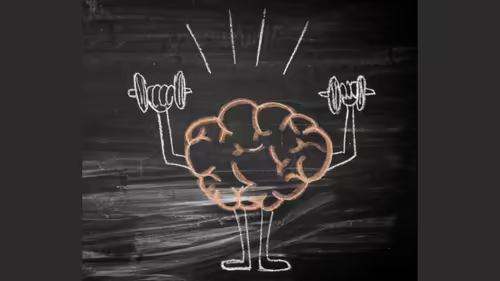
Conclusion: Your Brain Is a Muscle—Use It
The message is clear: brain exercises aren’t just for retirees or trivia buffs. In our fast-paced, distraction-filled world, proactive cognitive care is a necessity. By dedicating just 15–20 minutes a day to these five simple practices, you’re not just remembering names—you’re building a resilient, agile mind that can thrive for decades to come. Start today; your future self will thank you.
Sources
- Times of India: Forgetting names, losing focus? Neurologist says your brain needs these 5 exercises
- National Institute on Aging (NIA): Cognitive Health and Older Adults
- Interview with Dr. Amit Kumar Agarwal, Senior Consultant Neurologist, Amrita Hospital Faridabad