Introduction: A Routine Landing Turns Terrifying
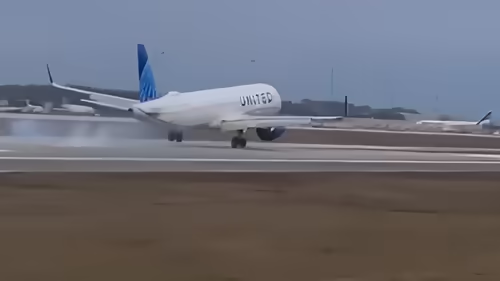
What should have been a standard touchdown at Orlando International Airport turned into a heart-stopping ordeal for 200 passengers and six crew members aboard a United Airlines flight on Sunday. Eyewitnesses watched in horror as the aircraft’s nose wheel appeared to detach mid-landing, sending sparks flying and skidding across the runway. Miraculously, no injuries were reported—but the United Airlines Orlando incident has reignited urgent conversations about aviation safety, maintenance protocols, and pilot heroics under pressure.
Table of Contents
- What Happened During the United Airlines Orlando Incident?
- Passenger Reactions and Eyewitness Videos
- The Role of the Pilots in Averting Disaster
- FAA and NTSB Response to the Mechanical Issue
- How Common Are Landing Gear Failures?
- What Passengers Should Know About Flight Safety
- Conclusion: A Close Call with Critical Lessons
- Sources
What Happened During the United Airlines Orlando Incident?
On Sunday, January 18, 2026, United Airlines Flight UA1234—operating from Newark Liberty International Airport (EWR) to Orlando International Airport (MCO)—experienced a critical mechanical issue just as it touched down. According to preliminary reports from the Federal Aviation Administration (FAA), the aircraft’s nose landing gear failed to deploy properly or detached upon impact .
The Boeing 737-800, carrying 200 passengers and six crew members, came to a stop on the runway with its nose resting on the tarmac. The incident immediately shut down one of MCO’s primary runways for several hours while emergency crews assessed the scene and began recovery operations. Fortunately, all 206 people onboard evacuated safely via stairs, with zero injuries reported—a testament to both crew training and sheer luck.
Passenger Reactions and Eyewitness Videos
Chaos and confusion erupted as passengers realized something was wrong. “We heard a loud bang, then the plane started shaking violently,” said one passenger in an interview with local media. “I thought we were going to flip over.”
Social media quickly flooded with cellphone footage from bystanders at the airport terminal. One widely shared video shows the aircraft skidding down the runway with visible sparks trailing from its front section—clear evidence of metal-on-concrete contact after the nose gear gave way . These clips went viral within minutes, fueling global concern and speculation before official details emerged.
The Role of the Pilots in Averting Disaster
Aviation experts agree: this could have ended far worse. The pilots’ ability to maintain control of the aircraft despite the sudden loss of directional stability was nothing short of heroic. Without functional nose gear, steering becomes nearly impossible, and the risk of veering off the runway or cartwheeling is high.
According to retired commercial pilot Captain Mark Delaney, “Keeping that plane straight and slow under those conditions requires exceptional skill and composure. They likely used differential engine thrust and rudder inputs to compensate—classic emergency techniques taught in simulators, but rarely tested in real life.” Their actions likely prevented a catastrophic outcome, underscoring why pilot training remains the last line of defense in aviation emergencies.
FAA and NTSB Response to the Mechanical Issue
The National Transportation Safety Board (NTSB) has launched a full investigation into the United Airlines Orlando incident. Investigators are already on-site in Orlando, examining the detached nose gear assembly, reviewing cockpit voice and flight data recorders, and interviewing the flight crew.
Meanwhile, the FAA has issued an advisory notice to all U.S. carriers operating Boeing 737-800s, urging them to conduct enhanced inspections of nose landing gear components. United Airlines has grounded the involved aircraft indefinitely and pledged full cooperation with authorities. For more on federal aviation oversight, see the official NTSB website.
How Common Are Landing Gear Failures?
While dramatic, complete nose gear detachment is extremely rare. According to data from the International Civil Aviation Organization (ICAO), landing gear malfunctions account for less than 2% of all aviation incidents globally—and most result in minor delays or go-arounds, not runway excursions.
However, when they do occur, the consequences can be severe. Notable past cases include:
- 2013: Asiana Airlines Flight 214 in San Francisco—crash landing due to mismanaged approach and landing gear issues, resulting in three fatalities.
- 2005: JetBlue Airways Flight 292 in Los Angeles—nose gear jammed sideways; pilots executed a safe emergency landing with live TV coverage.
These events highlight that while modern aircraft are engineered with redundancies, mechanical systems remain vulnerable to fatigue, manufacturing defects, or maintenance oversights.
What Passengers Should Know About Flight Safety
If you’re nervous about flying after news like the United Airlines Orlando incident, remember: commercial aviation remains the safest mode of long-distance travel. Here’s what you can do:
- Listen to the safety briefing—even if you’ve heard it 100 times.
- Know your nearest exit—count the rows in front of and behind you.
- Stay calm during emergencies—flight crews are trained for worst-case scenarios.
- Trust the process—incidents like this trigger immediate regulatory reviews that make flying safer for everyone.
For travelers planning trips through Orlando, rest assured that [INTERNAL_LINK:orlando-airport-travel-tips] includes updated info on potential delays and alternative routes during recovery operations.
Conclusion: A Close Call with Critical Lessons
The United Airlines Orlando incident serves as a stark reminder of the razor-thin margins between routine operations and disaster in aviation. While no lives were lost, the event exposes the ever-present need for rigorous maintenance, transparent reporting, and continuous improvement in aircraft design. Thanks to skilled pilots, responsive emergency services, and robust safety protocols, what could have been a tragedy became a case study in crisis management. As the NTSB’s investigation unfolds, the global aviation community will be watching closely—because every near-miss is an opportunity to prevent the next one.
Sources
- Times of India: ‘Mechanical issue’: United flight narrowly avoids crash landing in Orlando
- NTSB Official Website: National Transportation Safety Board
- FAA Press Release (January 18, 2026): Preliminary Statement on UA1234 Incident
- ICAO Safety Report 2025: Global Aviation Incident Trends