Introduction: Defiance in the Face of Defeat
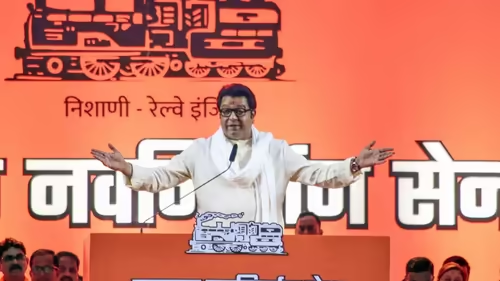
Political setbacks often lead to retreat. But not for Raj Thackeray. Following the Maharashtra civic elections where the Maharashtra Navnirman Sena (MNS) failed to meet its own expectations, the party’s charismatic leader has chosen confrontation over concession. In a bold and unapologetic address to his newly elected corporators, Thackeray declared: “Turn every municipal house into a MNS civic battleground.”
This isn’t just rhetoric—it’s a strategic pivot. Acknowledging the electoral outcome wasn’t “as expected,” Thackeray is now channeling disappointment into a militant agenda focused on two core pillars: dismantling the influence of money in local politics and fiercely defending Marathi identity in civic policy. For a party seeking relevance beyond electoral math, this could be its most consequential move yet.
Table of Contents
- The Electoral Reality: MNS Performance in Civic Polls
- Raj Thackeray’s Battle Cry: What Does a ‘Civic Battleground’ Mean?
- Targeting the ‘Rule of Money Power’
- Defending Marathi Interests in Municipal Halls
- Historical Context: MNS Tactics in Local Governance
- Conclusion: Can Defiance Translate into Influence?
- Sources
The Electoral Reality: MNS Performance in Civic Polls
The recently concluded civic elections across Maharashtra’s urban centers—including Mumbai, Pune, and Nagpur—saw dominant performances by the Shiv Sena (both factions) and the BJP. The MNS, once a formidable force in Mumbai’s political landscape, secured far fewer seats than it had hoped for .
Rather than spin the results, Raj Thackeray was unusually candid. “We did not get the numbers we wanted,” he admitted—a rare moment of public acknowledgment from a leader known for his defiant optimism. Yet, this honesty was quickly followed by a call to arms, signaling that the party’s influence would not be measured solely by seat count, but by its ability to disrupt and shape discourse from within the system.
Raj Thackeray’s Battle Cry: What Does a ‘Civic Battleground’ Mean?
The phrase “MNS civic battleground” is more than a metaphor—it’s a tactical blueprint. Thackeray instructed his corporators to be relentlessly combative inside municipal councils. This means:
- Opposing every resolution perceived as favoring corporate or out-of-state interests over local Marathi citizens.
- Using procedural tools like adjournment motions, point-of-order disruptions, and public hearings to stall or scrutinize decisions.
- Amplifying grievances through media and social platforms, turning council sessions into public spectacles of resistance.
- Building alliances with other opposition corporators, even from rival parties, on specific issues like housing rights or language policy.
In essence, the goal is to make governance so visibly contentious that the ruling parties are forced to either negotiate or face constant public backlash.
Targeting the ‘Rule of Money Power’
Thackeray’s central grievance is what he terms the “rule of money power”—a system where wealthy developers, contractors, and business lobbies allegedly dictate municipal agendas. He argues that this dynamic sidelines the common citizen and corrupts democratic processes at the grassroots level.
His corporators have been tasked with exposing this nexus. For example, they may challenge fast-tracked building permits, question inflated civic contracts, or demand transparency in public-private partnerships. This aligns with broader anti-corruption sentiments in Indian urban politics and could resonate with middle-class voters frustrated by opaque decision-making [[INTERNAL_LINK:urban-governance-india]].
Defending Marathi Interests in Municipal Halls
Beyond financial corruption, the MNS’s civic agenda remains deeply rooted in its core ideology: Marathi pride. Thackeray has directed his team to oppose any policy that, in their view, marginalizes Marathi-speaking residents—whether it’s language use in official signage, job quotas in civic projects, or housing allocation for migrants.
This stance is both a strength and a vulnerability. While it galvanizes the party’s traditional base, it risks alienating cosmopolitan urban voters who value inclusivity. Nevertheless, in the current political climate, identity-based mobilization remains a potent tool, and the municipal council offers a high-visibility platform to keep these issues alive.
Historical Context: MNS Tactics in Local Governance
This isn’t the first time the MNS has used obstruction as a strategy. During its peak in the late 2000s, the party’s corporators were known for walkouts, protests, and heated confrontations in the Brihanmumbai Municipal Corporation (BMC). Their aggressive style often dominated headlines, even when they held a minority of seats .
Now, Raj Thackeray appears to be reviving this playbook—but with a more structured, issue-based approach. By linking anti-money-power rhetoric with cultural protectionism, he’s attempting to reframe the MNS not as a fringe agitator, but as the conscience of urban Maharashtra. Whether this narrative sticks will depend on consistent performance and media savvy.
Conclusion: Can Defiance Translate into Influence?
The MNS civic battleground strategy is a high-risk, high-reward gamble. If executed effectively, it could reposition the party as a thorn in the side of complacent ruling coalitions, rebuilding its relevance ahead of the next state elections. But if it devolves into mere theatrics without tangible wins for citizens, it may cement the MNS’s image as a protest outfit with diminishing returns.
For now, Raj Thackeray has made his stance clear: in the corridors of municipal power, silence is surrender. And in his playbook, there’s no room for surrender.
Sources
- Times of India: After Maharashtra civic poll setback, Raj Thackeray asks MNS corporators to turn municipal houses into ‘battlegrounds’
- Election Commission of India: Official Website