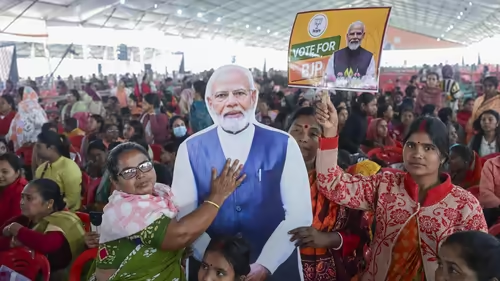
On a recent Sunday in Singur, the air was thick with political tension as Prime Minister Narendra Modi took to the stage, his voice echoing a familiar yet potent charge: it’s time to end the “maha jungle raj” in West Bengal . This wasn’t just another campaign speech; it was a direct assault on the Trinamool Congress (TMC) government and a clarion call for what he framed as a fundamental choice for the state’s future.
Table of Contents
- What Exactly is ‘Jungle Raj’? A Term Loaded with History
- Modi’s West Bengal Charge: Beyond Just Rhetoric
- The TMC’s Response and the 2026 Political Backdrop
- Why This ‘Jungle Raj’ vs. ‘Sushasan’ Battle Matters for Every Bengali
- Conclusion: The Road to 2026
- Sources
What Exactly is ‘Jungle Raj’? A Term Loaded with History
The phrase “jungle raj” isn’t new to Indian politics. It first gained notoriety during the 1990s in Bihar, used to describe a period of perceived lawlessness, rampant corruption, and a breakdown of civil order under the rule of Lalu Prasad Yadav’s government . The term, literally translating to “rule of the jungle,” evokes an image of a society where might makes right and institutions are rendered powerless .
For many, it became synonymous with governance at its worst—a system where criminals held sway, public services crumbled, and investor confidence vanished . When PM Modi uses this term for West Bengal, he’s deliberately invoking this powerful historical memory to paint a stark picture of the current state under the TMC.
Modi’s West Bengal Charge: Beyond Just Rhetoric
During his January 17, 2026, rally in Malda, and subsequent addresses, PM Modi didn’t just throw around the term “jungle raj” casually . He laid out a specific set of accusations:
- Law and Order Breakdown: He claimed that the state is plagued by violence and a lack of security, preventing normal life and economic activity.
- Blocked Central Schemes: Modi accused the TMC government of deliberately obstructing crucial central welfare programs from reaching the people of Bengal, thereby depriving them of their rightful benefits .
- Infiltration & Border Security: He alleged that the TMC regime has facilitated illegal infiltration, posing a threat to national security and the demographic balance of the state.
- Investor Flight: The Prime Minister argued that the prevailing “maha jungle raj” has destroyed investor confidence, stalling industrial growth and job creation in a state with immense potential .
His message was clear: the upcoming assembly elections are not just about a change in leadership but a binary choice between the TMC’s “jungle raj” and the BJP’s promise of “sushasan” or good governance . He pointed to the BJP-NDA’s own narrative of having ended a similar situation in Bihar as a model for what could be achieved in Bengal .
The TMC’s Response and the 2026 Political Backdrop
The Trinamool Congress, led by Chief Minister Mamata Banerjee, has predictably rejected these allegations as baseless and politically motivated. They have countered by highlighting their own development agenda and accusing the BJP of attempting to polarize the electorate along communal lines, especially in the wake of recent events in neighboring Bangladesh .
As the state gears up for the March-April 2026 assembly elections, the political landscape is intensely competitive . The BJP, after a strong showing in the last Lok Sabha polls, is pulling out all stops to unseat the TMC, which is seeking a historic fourth consecutive term . The party has launched a massive five-zone organizational blitz across the state to challenge the TMC’s bastions .
Why This ‘Jungle Raj’ vs. ‘Sushasan’ Battle Matters for Every Bengali
This isn’t just a war of words between two political heavyweights. The core issues raised—law and order, economic opportunity, and access to welfare—touch the lives of millions of ordinary citizens in West Bengal.
For a young graduate in Kolkata, the promise of “sushasan” translates to hope for jobs and a stable business environment. For a farmer in North Bengal, it’s about security and fair access to government schemes. The BJP’s strategy is to convince these voters that the status quo under the TMC is a barrier to their personal and collective progress.
Meanwhile, the TMC is banking on its grassroots connect and its narrative of being a regional bulwark against a centralizing BJP. The election will ultimately be a referendum on which vision of governance the people of Bengal trust more. You can learn more about the broader political dynamics in our deep dive on [INTERNAL_LINK:west-bengal-political-landscape].
Conclusion: The Road to 2026
PM Modi’s resurrection of the “jungle raj” slogan is a high-risk, high-reward political gambit. It’s a powerful, emotionally charged frame that cuts through complex policy debates and presents a simple, visceral choice to the electorate. Whether this narrative will resonate with the voters of West Bengal remains to be seen, but one thing is certain: the battle lines for the 2026 assembly elections have been drawn in the starkest possible terms. The fight for Bengal’s soul is well and truly on.
Sources
- Times of India. “‘Jungle raj’ must end for growth: PM Modi in West Bengal; attacks TMC govt”. https://timesofindia.indiatimes.com/…
- The Hindu. “PM calls for ending ‘maha jungle raj’ in Bengal”. https://www.thehindu.com/…
- India Today. “In Bihar, PM Modi explained the meaning of ‘Jungle Raj'”. https://www.indiatoday.in/…
- Election Commission of India. “West Bengal Assembly Election Schedule”. https://eci.gov.in/