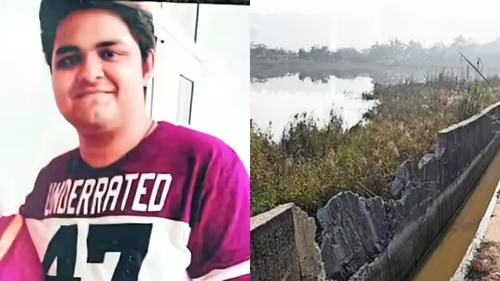
It was supposed to be just another evening drive home. Instead, it became a nightmare that ended a young life and exposed shocking lapses in urban safety. In Noida’s rapidly developing Sector 150, a 28-year-old software engineer tragically drowned after his car veered into a deep, water-filled excavation pit—left completely **unfenced, unlit, and invisible** in the dark . The incident has sparked public outrage, led to the sacking of a municipal junior engineer, and resulted in a criminal FIR against two prominent real estate developers: MZ Wishtown Planners and Lotus Greens Construction . This isn’t just an accident—it’s a preventable tragedy rooted in systemic negligence.
Table of Contents
- What Happened in the Noida Pit Drowning?
- FIR Filed and Official Sacked
- Who Owns the Land? Builder Accountability Under Scrutiny
- Are Noida’s Construction Sites Safe? A Broader Crisis
- Legal and Regulatory Fallout
- A Wake-Up Call for Urban India
- Sources
What Happened in the Noida Pit Drowning?
The victim, identified as a resident of Greater Noida West, was returning home late at night when his vehicle reportedly missed a turn and drove straight into a massive water-filled pit on a plot earmarked for future development . With no boundary wall, no reflective markers, and no warning signs, the pit—estimated to be over 15 feet deep—became a death trap. Bystanders heard the splash and raised the alarm, but by the time rescue teams arrived, it was too late. The engineer was pulled out unconscious and pronounced dead at the hospital .
Disturbingly, local residents had repeatedly complained to authorities about the hazardous condition of this and other nearby plots. Yet, no action was taken. The absence of even basic safety measures like temporary fencing or hazard lights turned what should have been a routine commute into a fatal detour.
FIR Filed and Official Sacked
In response to mounting public pressure and media scrutiny, the Noida Police swiftly registered an FIR under Section 304 (culpable homicide not amounting to murder) of the Indian Penal Code. The case names officials from both MZ Wishtown Planners and Lotus Greens Construction as accused, holding them responsible for failing to secure their construction site .
Simultaneously, the Noida Authority took internal disciplinary action. A junior engineer from the Projects Department, who was directly responsible for monitoring the site’s compliance with safety norms, was summarily dismissed from service . This rare move signals the administration’s attempt to demonstrate accountability—but many argue it’s merely the tip of the iceberg.
Who Owns the Land? Builder Accountability Under Scrutiny
Preliminary investigations revealed that the land where the pit was dug is jointly owned by MZ Wishtown Planners and Lotus Greens—a joint venture common in large-scale real estate projects. Under the Real Estate (Regulation and Development) Act, 2016 (RERA), developers are legally obligated to ensure the safety of their project sites, even during the pre-construction phase .
Key safety failures in this case include:
- No perimeter fencing around the excavation area.
- Absence of reflective warning signs or barricades visible at night.
- No lighting to mark the hazard zone.
- Lack of drainage or water removal, allowing rainwater to accumulate and deepen the pit.
These omissions aren’t just careless—they’re a direct violation of standard construction safety protocols followed globally. For context, the International Labour Organization (ILO)’s guidelines on construction site safety explicitly mandate physical barriers and clear signage around all open excavations to prevent exactly this kind of incident .
Are Noida’s Construction Sites Safe? A Broader Crisis
This Noida pit drowning is not an isolated event. Over the past five years, similar accidents have occurred across the National Capital Region (NCR), often involving children or unsuspecting pedestrians falling into uncovered manholes, trenches, or pits [[INTERNAL_LINK:noida-infrastructure-safety-crisis]]. Rapid urbanization, coupled with lax enforcement of safety regulations, has created a dangerous environment where development comes at the cost of human life.
Residents’ welfare associations in Noida have long demanded stricter oversight from the Authority. “We’ve sent multiple letters about unsafe plots near schools and residential areas,” said a local activist. “But nothing happens until someone dies.”
Legal and Regulatory Fallout
Beyond the current FIR, the case could trigger wider consequences:
- RERA Penalties: The Uttar Pradesh RERA may initiate separate proceedings against the builders for violating safety clauses in their project registration.
- Civil Liability: The victim’s family is likely to file a civil suit seeking compensation for wrongful death due to negligence.
- Policy Review: The Noida Authority may be forced to revise its inspection protocols and impose mandatory safety audits for all undeveloped plots.
The sacking of the junior engineer, while symbolic, raises questions about systemic failure. Was he under-resourced? Were higher-ups aware of the risks? These are issues that a thorough judicial inquiry must address.
A Wake-Up Call for Urban India
The drowning of a young techie in an unsecured pit in Noida is more than a news story—it’s a stark indictment of how urban development is often prioritized over public safety. The filing of an FIR against major builders and the dismissal of a municipal official are necessary first steps, but they cannot bring back a life lost to sheer negligence. As cities expand, the responsibility to protect citizens from hidden hazards must fall squarely on developers, regulators, and civic authorities alike. This tragedy must serve as a catalyst for enforceable, non-negotiable safety standards across every construction site in India.
Sources
- Times of India: “‘No boundary wall’: FIR against 2 after techie drowns in Noida pit; junior engineer sacked” (January 19, 2026)
- Noida Police official statement on FIR registration (January 18, 2026)
- Hospital records and eyewitness accounts from Sector 150 residents
- Noida Authority press release on staff suspension (January 19, 2026)
- Real Estate (Regulation and Development) Act, 2016 – Section 14 (Obligations of Promoter)
- International Labour Organization (ILO): “Safety and Health in Construction Convention, 1988 (No. 167)”