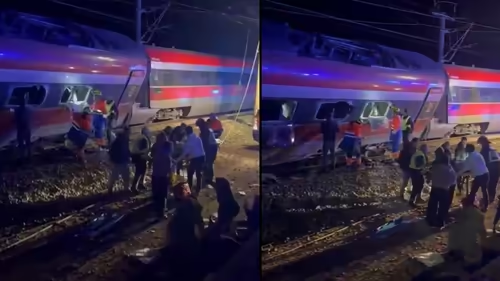
A nation is in mourning after a scene of unimaginable horror unfolded on the Spanish railway network. On the evening of Sunday, January 18, 2026, a catastrophic Spain train crash near the town of Adamuz in the Cordoba province claimed at least 21 lives and left more than 100 people injured, with 25 in serious condition . The collision between two high-speed passenger trains has sent shockwaves across the country and raised urgent questions about rail safety.
Table of Contents
- What Happened in the Spain Train Crash?
- Victims and the Heroic Rescue Effort
- What Caused the High-Speed Train Collision?
- Immediate Impact on National Rail Services
- Historical Context: Spain’s Rail Safety Record
- Summary and Ongoing Developments
- Sources
What Happened in the Spain Train Crash?
The disaster struck at approximately 7:45 p.m. local time. According to initial reports, the tail end of an evening high-speed train traveling from Malaga to Madrid, carrying around 300 passengers, derailed near Adamuz . This derailed section then collided with an oncoming Alvia service on the adjacent track . The force of the impact was devastating, crumpling carriages and trapping numerous passengers inside the wreckage. Disturbing videos from the scene showed survivors desperately crawling out of shattered windows to escape the mangled metal .
Victims and the Heroic Rescue Effort
The human cost of this tragedy is staggering. The official death toll stands at 21, though some early reports suggested it could be as high as 24 [[1], [10]]. Among the deceased were passengers from both trains involved in the collision . Over 100 people were injured, with emergency services working through the night in a race against time to save those critically wounded .
Hundreds of emergency personnel, including firefighters, medical teams, and members of the Civil Guard, were deployed to the remote crash site. Their efforts were hampered by the location and the severity of the wreckage, which required specialized cutting equipment to free trapped victims. The regional government of Andalusia declared a regional emergency to mobilize all necessary resources for the rescue and recovery operation.
What Caused the High-Speed Train Collision?
The precise cause of this horrific Spain train crash remains a mystery and is now the subject of a major investigation. Authorities from Spain’s rail infrastructure manager, ADIF, along with judicial officials, have launched a comprehensive probe to determine the sequence of events that led to the derailment and subsequent collision .
Potential factors under scrutiny include:
- Mechanical failure of the train or its components.
- Human error by the train driver or signaling staff.
- Track conditions or a potential obstruction on the line.
- Signaling system malfunction that may have failed to prevent the oncoming train from entering the compromised section of track.
Until the investigation concludes, all speculation remains just that—speculation. However, the incident has already ignited a fierce public debate about the safety protocols governing Spain’s extensive high-speed rail network.
Immediate Impact on National Rail Services
In the immediate aftermath of the collision, all high-speed train services on the critical corridor between Madrid and Andalusia were suspended indefinitely . This major disruption has stranded thousands of travelers and forced many to seek alternative transportation, such as flights or long-distance buses. The suspension is expected to remain in place until the damaged section of track can be fully inspected, repaired, and deemed safe for operation. For the latest travel updates, passengers are advised to check the official Renfe website or contact their ticket provider.
Historical Context: Spain’s Rail Safety Record
This tragic event is a grim reminder of a similar disaster that occurred in 2013 near Santiago de Compostela, where a high-speed train derailed, killing 79 people. That accident was attributed to excessive speed and led to significant reforms in Spain’s rail safety management. While the country’s high-speed AVE network is generally considered one of the safest and most efficient in Europe, this new Spain train crash near Cordoba is a devastating setback that will inevitably prompt a thorough review of current safety measures and operational procedures [[INTERNAL_LINK:spain-rail-safety-history]].
For an authoritative perspective on global rail safety standards, you can refer to the International Union of Railways (UIC) guidelines on risk management and prevention.
Summary and Ongoing Developments
The high-speed train collision near Cordoba on January 18, 2026, is one of the deadliest transportation disasters in Spain in over a decade. With at least 21 confirmed fatalities and more than 100 injured, the nation is grappling with a profound sense of loss. A massive rescue operation has transitioned into a complex recovery and forensic investigation. The cause of the derailment that triggered the chain of events is unknown, but a full inquiry is underway. In the meantime, a vital artery of Spain’s rail network remains closed, and the families of the victims are left to mourn. This story is still developing, and further updates are expected as the investigation progresses.
Sources
- Web Search Result: “2026 Adamuz train derailments”
- Web Search Result: “High-speed trains collide after one derails in southern”
- Web Search Result: “At least 21 dead and dozens injured after high-speed train”
- Web Search Result: “Two high-speed trains collide in Spain, killing at least 10”
- Web Search Result: “Death toll in Spain high-speed train derailment rises to 21”
- Web Search Result: “Train collision in Spain kills 21, injures dozens”
- Web Search Result: “Spain train crash latest: At least 21 dead and more than”