Table of Contents
- The Bengaluru Dashcam Horror Unfolds
- Who Is Sayed Arbaz Khan? A Troubled Past
- How Dashcam Footage Became Key Evidence
- Rising Road Rage in Indian Cities
- Legal Consequences and Police Response
- What Drivers Can Do to Stay Safe
- Conclusion: A Wake-Up Call for Urban India
- Sources
The Bengaluru Dashcam Horror Unfolds
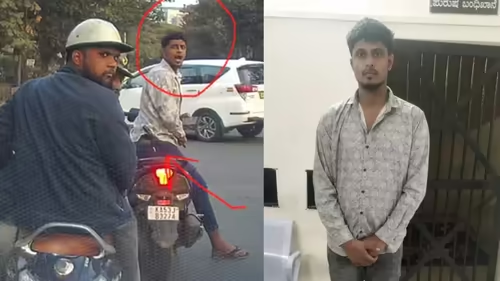
It started as a routine evening drive near Nexus Shantiniketan Mall in Bengaluru—but within seconds, it turned into a nightmare. A minor traffic spat escalated into a terrifying confrontation when a 25-year-old man, later identified as Sayed Arbaz Khan, began shouting at a family in their car. Then, he pulled out a knife.
The entire incident was captured on the family’s dashcam—a piece of technology that has increasingly become a lifeline for motorists in India’s congested urban centers. The video shows Khan leaning into the vehicle, waving the blade inches from the occupants while hurling abuses. The family, including children, remained locked inside, visibly shaken but unharmed .
This Bengaluru dashcam horror quickly went viral on social media, sparking outrage and renewed debate about road safety and public aggression in India’s tech capital.
Who Is Sayed Arbaz Khan? A Troubled Past
Police records reveal that Sayed Arbaz Khan is no stranger to law enforcement. According to the Bengaluru City Police, he has been arrested multiple times in the past for offenses ranging from assault to public nuisance . His latest act of aggression appears to be part of a pattern of volatile behavior.
Khan was apprehended within 24 hours of the incident, thanks to clear visuals from the dashcam and public tips. During interrogation, he reportedly admitted to carrying the knife “for self-defense”—a claim authorities dismissed given the unprovoked nature of the threat .
His history raises serious questions about gaps in monitoring repeat offenders and whether preventive measures could have averted this scare.
How Dashcam Footage Became Key Evidence
In an era where eyewitness accounts can be disputed, the family’s dashcam proved invaluable. The high-definition video provided:
- Clear facial identification of the accused
- Exact time and location (near Whitefield’s busy mall junction)
- Audio of verbal threats and aggressive language
- Visual proof of the knife being brandished
Within hours of the footage being shared with police, a First Information Report (FIR) was filed under IPC Sections 506 (criminal intimidation) and 324 (voluntarily causing hurt by dangerous weapons) .
[INTERNAL_LINK:dashcam-laws-india] While dashcams are not yet mandatory in India, incidents like this underscore their growing importance—not just for insurance claims, but for personal safety and justice.
Rising Road Rage in Indian Cities
The Bengaluru dashcam horror is not an isolated case. According to the National Crime Records Bureau (NCRB), road rage incidents in urban India have risen by over 37% since 2019 . Factors include:
- Increasing traffic congestion
- Stress from long commutes
- Lack of conflict-resolution awareness
- Easy access to weapons (like knives or rods)
Cities like Delhi, Mumbai, and Hyderabad have reported similar altercations—some ending in fatalities. Bengaluru, despite its reputation as a cosmopolitan hub, is not immune. In fact, its rapid urbanization without proportional infrastructure growth has created a pressure cooker environment on the roads.
Legal Consequences and Police Response
Following public outcry, the Bengaluru Traffic Police launched a special drive against aggressive driving and weapon-carrying motorists. Khan is currently in judicial custody, and prosecutors are seeking enhanced charges due to the presence of minors during the threat.
Legal experts note that if convicted under Section 324, Khan could face up to three years in prison—and possibly more if the court considers the psychological trauma inflicted on the family .
Authorities have also urged citizens to report such incidents immediately and to install dashcams as a deterrent. “Visibility is accountability,” said a senior police official in a press briefing .
What Drivers Can Do to Stay Safe
While systemic change is needed, individual drivers can take proactive steps:
- Install a front-and-rear dashcam with cloud backup.
- Avoid engagement during confrontations—lock doors and drive to the nearest police station or crowded area.
- Report incidents immediately via the 112 emergency number or local traffic helpline.
- Never carry weapons in vehicles—even for “self-defense”—as they can escalate situations.
Community awareness and digital vigilance are becoming essential tools in the fight against urban aggression.
Conclusion: A Wake-Up Call for Urban India
The Bengaluru dashcam horror is more than a viral video—it’s a stark reminder of how quickly civility can collapse on our roads. While the swift arrest of Sayed Arbaz Khan offers some justice, it also highlights deeper issues: inadequate mental health support, weak enforcement of traffic laws, and the normalization of aggression in daily life. As cities grow, so must our collective responsibility to drive with patience, empathy, and respect.