Table of Contents
- The Operation Trashi-I Encounter
- Why Kishtwar? A Strategic Hotspot
- Republic Day and the Shadow of Terror
- The Broader Terror Landscape in Jammu
- Conclusion: A Test of Resolve
- Sources
The Operation Trashi-I Encounter: A Fierce Battle in the Chenab Valley
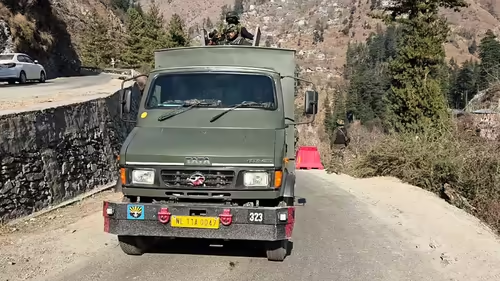
Sunday, January 18, 2026, turned into a day of high tension and bravery in the rugged terrains of Jammu and Kashmir. In a remote, forested area of the Kishtwar district, a joint operation by the Indian Army and the Jammu and Kashmir Police—dubbed Operation Trashi-I—led to a fierce gunfight with suspected foreign terrorists . The encounter, which began around noon, quickly escalated as the militants, believed to be from the Jaish-e-Mohammad outfit, used grenades and heavy fire to resist the security forces [[4], [9]].
The result was a sobering one: eight brave soldiers from the Army’s White Knight Corps were injured in the line of duty [[3], [8]]. Reports indicate that three of them were airlifted to a hospital for urgent medical care, highlighting the intensity of the clash . Reinforcements were immediately deployed, and a massive combing operation is now underway to track down and neutralize the remaining militants, who are thought to number between two and three [[1], [5]].
This incident is not just another entry in the daily news cycle. It’s a stark reminder of the persistent and evolving threat that security forces face in the region. For our readers following the situation in J&K, this is a critical development that demands attention.
Why Kishtwar? A Strategic Hotspot in the Himalayas
One might wonder why this remote district has become a focal point for such a high-stakes operation. Kishtwar isn’t just any location; it’s a place of immense strategic importance. Nestled in the Chenab Valley, it acts as a geographical bridge between South Kashmir and the Pir Panjal ranges . Its vast, rugged terrain—spanning over 7,800 square kilometers of dense deodar, fir, and pine forests—provides ideal cover for infiltrators looking to evade detection [[21], [29]].
Beyond its geography, Kishtwar is home to critical national infrastructure, including major hydroelectric power projects like Dul Hasti and Pakal Dul . This combination of difficult-to-patrol wilderness and vital assets makes it a prime target for terrorist groups seeking to disrupt stability and draw attention to their cause. Understanding the significance of Kishtwar is key to grasping the full context of Operation Trashi-I.
Republic Day and the Shadow of Terror: A Deliberate Timing?
The timing of this encounter is deeply concerning. With India’s 77th Republic Day celebrations just a week away on January 26, 2026, security across Jammu and Kashmir has been massively heightened as a standard precaution [[14], [16]]. Authorities have implemented a multi-tier security grid, leveraging advanced technology like night vision devices and high-resolution cameras to monitor suspicious activity .
Historically, terrorist outfits have attempted to spoil national celebrations by orchestrating violent incidents. The fact that this is the third major encounter in the Jammu region this year alone suggests a concerted effort to test the nation’s defenses during this sensitive period . The security apparatus is clearly on high alert, but the events in Kishtwar prove that the threat remains potent and unpredictable. This raises serious questions about the intelligence inputs and the challenges of securing such a vast and complex landscape.
The Broader Terror Landscape in Jammu: A Shifting Focus
For years, the Kashmir Valley was the epicenter of terrorist activity in the union territory. However, recent years have seen a worrying shift, with the Jammu region—including districts like Rajouri, Poonch, and now Kishtwar—becoming new hotspots. This tactical shift by terrorist groups aims to open new fronts and stretch the security forces thin.
Just weeks before the Kishtwar incident, a similar operation was underway in Kathua, another Jammu district, to track down terrorists . This pattern indicates a broader strategy at play. The security forces have responded with intensified counter-terrorism operations, but the terrain and the element of surprise often work in the militants’ favor. For anyone tracking the security situation in India, this trend in the Jammu region is a critical development that cannot be ignored. It signals a new phase in the long-standing conflict, one that requires a fresh set of strategies and resources.
Conclusion: A Test of Resolve for India’s Security Forces
The gunfight in Kishtwar under Operation Trashi-I is more than just a local incident. It’s a microcosm of the larger, ongoing struggle against terrorism in Jammu and Kashmir. The injury of eight soldiers is a painful cost of the peace we often take for granted. As the massive hunt for the remaining militants continues, the entire nation watches with bated breath.
This event underscores the relentless dedication of our armed forces and the complex, ever-present dangers they face, especially in the lead-up to a major national event like Republic Day. The resolve of our security forces will be tested in the coming days, and their success in neutralizing this threat will be crucial for the region’s stability. We stand with them and honor their sacrifice.
Sources
- Original Article: Times of India – Operation Trashi-I: Gunfight breaks out in J&K’s Kishtwar
- Indian Army’s White Knight Corps statement on Operation Trashi-I
- Details on Jaish-e-Mohammad involvement and grenade use [[4], [9]]
- Geographical and strategic importance of Kishtwar district [[20], [21], [22], [29]]
- Republic Day security measures in J&K [[14], [16], [19]]
- Terror activity trends in the Jammu region