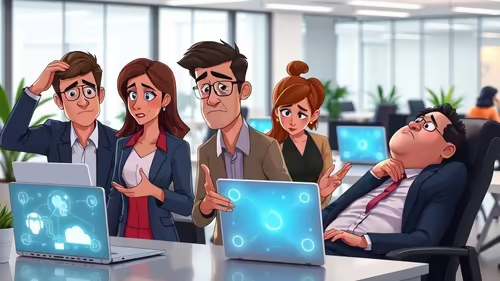
Artificial intelligence isn’t coming to the workplace—it’s already here. From automating routine tasks to generating strategic insights, AI tools are being rolled out faster than ever. But there’s a growing crisis simmering beneath the surface: employees are being handed powerful new technologies without the training or guidance to use them effectively. A recent report by Genius HRTech paints a stark picture—while organizations race to implement AI at work, they’re leaving their people behind .
Table of Contents
- The Alarming AI Adoption vs. Training Gap
- Why Employees Feel Unprepared for AI-Driven Changes
- The Real Cost of Neglecting AI Skilling
- What Forward-Thinking Companies Are Doing Differently
- A Practical Roadmap for Closing the AI Readiness Gap
- Conclusion: AI Success Starts with People
- Sources
The Alarming AI Adoption vs. Training Gap
The Genius HRTech report delivers hard truths that HR leaders can’t ignore. While 71% of professionals believe their roles will change significantly due to AI integration, a staggering 61% say their organization has provided little to no guidance on navigating these shifts . Even more concerning? Only 37% of employees have received any formal AI at work training.
This mismatch isn’t just a logistical oversight—it’s a strategic risk. Companies are investing millions in AI systems expecting immediate ROI, but without a skilled workforce to leverage them, those investments may yield diminishing returns or even backfire through misuse, inefficiency, or employee disengagement.
Why Employees Feel Unprepared for AI-Driven Changes
The anxiety isn’t unfounded. AI doesn’t just automate tasks—it reshapes entire job functions. A marketing analyst might now need to interpret AI-generated customer sentiment models. A customer service rep may collaborate with an AI co-pilot to resolve complex queries. Yet, many workers are being asked to adapt without clarity on what’s expected of them.
Three key factors fuel this sense of unpreparedness:
- Lack of role-specific training: Generic “AI awareness” sessions don’t equip employees to apply AI in their daily workflows.
- Poor communication from leadership: Many companies roll out AI tools without explaining the “why” or the future vision for human-AI collaboration.
- Fear of obsolescence: Without reassurance and upskilling pathways, employees worry their jobs will disappear rather than evolve.
The Real Cost of Neglecting AI Skilling
Ignoring the human side of AI adoption carries tangible consequences:
- Reduced productivity: Employees waste time figuring out tools on their own or avoid using them altogether.
- Increased turnover: Top talent leaves organizations that fail to invest in their future relevance.
- Ethical and compliance risks: Untrained users may misuse AI, leading to biased outputs, data leaks, or regulatory violations.
- Stalled innovation: AI’s full potential is unlocked only when humans know how to ask the right questions and interpret results critically.
As the World Economic Forum notes in its Future of Jobs Report 2025, 44% of workers’ core skills will be disrupted by 2028—and AI is a primary driver . Companies that treat skilling as an afterthought will fall behind competitors who embed continuous learning into their AI strategy.
What Forward-Thinking Companies Are Doing Differently
Not all organizations are asleep at the wheel. Industry leaders are taking proactive steps to align technology with talent:
- Co-creating AI roadmaps with employees: Involving staff in pilot programs builds trust and surfaces real-world use cases.
- Implementing tiered training: From foundational literacy for all to advanced prompt engineering for specialists.
- Linking AI skills to career progression: Certifications and micro-credentials are tied to promotions and pay increases.
- Establishing AI “help desks”: Dedicated internal support teams answer questions and troubleshoot issues in real time.
For example, companies like Accenture and Microsoft have launched enterprise-wide AI academies, ensuring every employee—from finance to HR—understands how AI impacts their domain .
A Practical Roadmap for Closing the AI Readiness Gap
If your organization is playing catch-up, it’s not too late. Here’s a three-step action plan:
- Assess & Map: Conduct a skills gap analysis. Identify which roles will change most and what competencies are needed.
- Design & Deliver: Create role-based, hands-on training modules—not just theory. Use simulations and real data.
- Embed & Evolve: Make AI learning continuous, not one-off. Integrate feedback loops to refine training as tools evolve.
Remember, the goal isn’t to turn everyone into data scientists. It’s to build AI fluency—the ability to collaborate with intelligent systems confidently and ethically.
Conclusion: AI Success Starts with People
The race to adopt AI at work won’t be won by who deploys the fanciest algorithms—but by who empowers their people to use them wisely. The Genius HRTech findings are a wake-up call: technology without training is just expensive chaos. Companies that prioritize human readiness alongside digital transformation will not only retain talent but unlock unprecedented levels of innovation and resilience. For more on building future-ready teams, explore our guide on [INTERNAL_LINK:future-of-work-strategies].
Sources
- Times of India: AI at work: Adoption outpaces employee training; majority feel unprepared for role changes
- World Economic Forum: The Future of Jobs Report 2025
- McKinsey & Company: What is generative AI—and how can businesses use it?