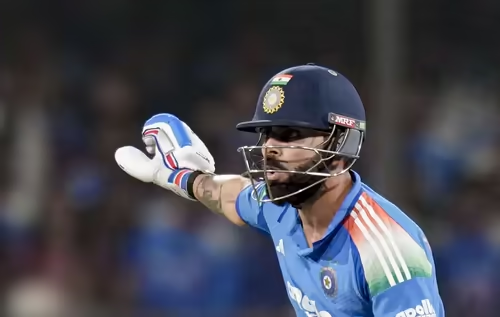
On a sun-drenched but ultimately heartbreaking day in Indore, Indian cricket suffered a historic wound. The mighty Men in Blue, long considered invincible on their home turf, were humbled by a resolute New Zealand side that etched its name into the history books. The NZ first bilateral series win in India is not just a statistic; it’s a seismic shift in the balance of power in world cricket .
Table of Contents
- The Historic Defeat: A Decade in the Making
- Kohli’s Heroics in Vain: A Lone Warrior
- Mitchell and Phillips: The Architects of History
- Why India Collapsed Under Pressure
- What This Means for Indian Cricket
- Conclusion: A New Era Dawns
- Sources
The Historic Defeat: A Decade in the Making
This wasn’t just another series loss. This was a first. In eight previous attempts since 1988, New Zealand had never managed to win a bilateral ODI series in India . The Holkar Stadium in Indore, a fortress where India had won all seven of its previous ODIs, became the stage for a monumental upset . The final scorecard—a 41-run victory for the Kiwis in the third ODI—tells a story of a complete team effort from New Zealand and a collective failure from the Indian batting unit beyond its superstar .
Kohli’s Heroics in Vain: A Lone Warrior
At the heart of this tragedy was a moment of pure brilliance. Virat Kohli, the talisman, delivered yet again with a scintillating 124 off just 108 balls . It was his 54th ODI century, a masterclass in controlled aggression against a high-quality bowling attack . He found some support from Harshit Rana (52) and Rajat Patidar (53), but once Kohli was dismissed, the innings folded like a house of cards . His valiant effort was a stark reminder of his enduring class, but also a painful symbol of the team’s over-reliance on its senior players in high-stakes chases .
Mitchell and Phillips: The Architects of History
While Kohli fought a lone battle, New Zealand’s victory was built on a foundation of a record-breaking partnership. Daryl Mitchell and Glenn Phillips put on a devastating 219 runs for the fourth wicket, a platform that proved insurmountable for the Indian bowlers .
Mitchell, who now boasts an astonishing average of 74.10 against India in ODIs, anchored the innings with a composed 137 off 131 balls . Phillips, playing the aggressor, smashed a blistering 106 off just 88 deliveries, showcasing the fearless brand of cricket that has become New Zealand’s trademark . Their contrasting styles meshed perfectly to post a formidable total of 337/8, a score that demanded a near-perfect response from India—which never materialized .
Why India Collapsed Under Pressure
Chasing 338 is a tall order, but one that a team of India’s caliber should be able to handle at home. So, what went wrong? The answer lies in a familiar narrative: a lack of depth in the middle order. Once the top order, including Shubman Gill and Shreyas Iyer, failed to fire, the pressure mounted on Kohli and the lower-middle order. The collapse from a promising position to being all out for 296 in just 46 overs highlighted a critical vulnerability .
The team’s inability to build substantial partnerships outside of the Kohli-Rana stand was the key difference. In contrast to New Zealand’s 219-run partnership, India’s next best was just 59 runs. This lack of collective responsibility is a major concern for the management as they look ahead to future challenges.
What This Means for Indian Cricket
This loss is more than just a blip on the radar. It’s a wake-up call. For too long, Indian cricket has coasted on its home advantage and the brilliance of its star players. This historic defeat exposes the fragility of a system that hasn’t adequately grafted a new generation of consistent match-winners across all formats. The team’s over-dependence on Kohli, even in 2026, is a strategic flaw that opponents are learning to exploit.
This series loss should prompt a serious introspection within the BCCI and the team management. Questions about team composition, the role of young players, and the overall game plan in high-pressure chases need to be addressed immediately. For a deeper look at India’s recent ODI struggles, see our analysis on [INTERNAL_LINK:india-odi-batting-collapse-analysis].
Conclusion: A New Era Dawns
The NZ first bilateral series win in India is a watershed moment for both teams. For New Zealand, it’s a testament to their growth, resilience, and world-class talent. For India, it’s a painful but necessary lesson in humility. Cricket is a game of glorious uncertainties, and this series has proven that no fortress is impregnable. The onus is now on Team India to regroup, rebuild, and ensure that such a historic home defeat remains a rare anomaly and not a recurring theme.
Sources
- Times of India: IND vs NZ: Kohli’s 124 in vain; NZ clinch first-ever bilateral series in India
- ESPNcricinfo: India vs New Zealand, 3rd ODI Live Scorecard
- International Cricket Council (ICC): New Zealand make history with series win in India