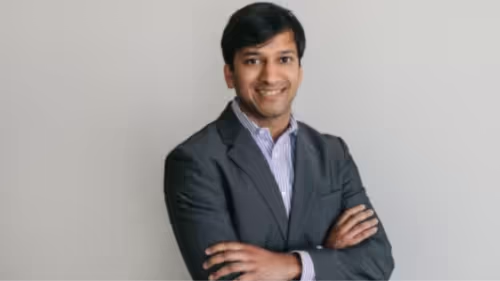
On a crisp January morning in 2026, history was made in Jersey City—not with fanfare or fireworks, but with quiet dignity and a sacred text. **Keshav Poddar**, an Indian-American attorney and longtime community advocate, was officially sworn in as the city’s new Deputy Mayor. And in a deeply personal and symbolic gesture, he placed his hand not on a Bible, but on the Bhagavad Gita—a first for the office .
This moment transcends politics. It’s a testament to how far the Indian-American community has come in U.S. civic life—and a beacon for millions of young South Asians who now see themselves reflected in positions of real power. As one observer put it: “He didn’t just take an oath. He carried a legacy.”
Table of Contents
- Who Is Keshav Poddar?
- A Historic Oath on the Bhagavad Gita
- His Road to Deputy Mayor
- What Does the Deputy Mayor of Jersey City Actually Do?
- Why This Matters for the Indian-American Community
- Broader Trends: South Asians Rising in U.S. Politics
- Conclusion: Representation That Resonates
- Sources
Who Is Keshav Poddar?
**Keshav Poddar** isn’t a political newcomer. A graduate of Rutgers Law School, he’s spent over a decade working at the intersection of law, public policy, and community development in Hudson County. Before his appointment, he served as a senior advisor to Mayor Steven Fulop, focusing on housing equity, small business support, and immigrant integration initiatives.
Born to Indian immigrants from Gujarat, Poddar grew up in Edison, New Jersey—a town with one of the highest concentrations of Indian-Americans in the U.S. His parents ran a small pharmacy, instilling in him values of service, discipline, and education. “They taught me that success isn’t just about what you achieve, but who you lift up along the way,” he once said in a local interview .
Now in his late 30s, Poddar is known for his pragmatic approach, consensus-building skills, and deep roots in Jersey City’s diverse neighborhoods—from Journal Square to Greenville.
A Historic Oath on the Bhagavad Gita
The choice to swear on the Bhagavad Gita was both personal and political. The 700-verse Hindu scripture, part of the epic Mahabharata, is revered for its teachings on duty (dharma), righteousness, and selfless action—principles that resonate deeply with public service.
While U.S. law allows officials to use any religious or secular text for their oath, seeing the Gita used in a high-profile municipal ceremony is still rare. Previous Indian-American officials—like former Louisiana Governor Bobby Jindal—opted for the Bible, often citing assimilation or political pragmatism.
Poddar’s decision signals a growing confidence in cultural identity among second-generation Americans. “This isn’t about religion,” he clarified during his swearing-in. “It’s about honoring where I come from while serving everyone in this city—regardless of faith, origin, or zip code.”
His Road to Deputy Mayor
Poddar’s ascent wasn’t overnight. His journey includes:
- Volunteering with local nonprofits supporting immigrant seniors.
- Co-founding a legal aid clinic for undocumented workers.
- Serving as chair of Jersey City’s Housing Trust Fund oversight board.
- Leading pandemic relief efforts in underserved communities during 2020–2022.
His work earned bipartisan respect, even in a politically charged environment. When Mayor Fulop announced Poddar’s appointment, he praised his “unshakeable integrity and relentless focus on equity” .
What Does the Deputy Mayor of Jersey City Actually Do?
Unlike some ceremonial roles, Jersey City’s Deputy Mayor holds significant operational authority. Key responsibilities include:
- Acting as mayor in the mayor’s absence.
- Overseeing interdepartmental coordination on major initiatives (e.g., affordable housing, transit).
- Representing the city at regional forums like the North Jersey Transportation Planning Authority.
- Managing crisis response protocols during emergencies.
With Jersey City’s population surpassing 300,000—and over 25% foreign-born—the role demands cultural fluency and administrative precision. Poddar’s background makes him uniquely suited for the task.
Why This Matters for the Indian-American Community
For a community that has long excelled in STEM and business but remained underrepresented in elected office, Poddar’s rise is symbolic and strategic. Indian-Americans are the fastest-growing immigrant group in the U.S., yet hold fewer than 0.5% of all local elected positions nationwide .
His visibility can inspire a new generation to engage beyond voting—to run, lead, and shape policy. As one young Indian-American activist in Jersey City told us: “Seeing someone who looks like my dad in City Hall? That changes everything.” [INTERNAL_LINK:indian-americans-in-politics]
Broader Trends: South Asians Rising in U.S. Politics
Poddar is part of a quiet but accelerating wave. Consider these milestones:
- Rep. Pramila Jayapal (WA): First Indian-American woman in Congress.
- Gov. Nikki Haley (SC): First female Indian-American governor.
- Mayor Satya Rhodes-Conway (Madison, WI): First openly LGBTQ+ South Asian mayor.
- Over 100 South Asian Americans now serve in state and local offices across 30+ states .
Organizations like South Asian Americans Leading Together (SAALT) have been instrumental in training candidates and building pipelines. Poddar’s success adds momentum to this movement.
Conclusion: Representation That Resonates
**Keshav Poddar**’s swearing-in on the Bhagavad Gita is more than a photo op—it’s a quiet revolution. It shows that American democracy isn’t just about assimilation, but about inclusion in its fullest sense: bringing your whole self to the table, scripture and all.
As Jersey City navigates challenges from climate resilience to economic inequality, having a leader who embodies both global heritage and local commitment could be its greatest asset. For Indian-Americans watching from Edison to Edison (Kansas), this moment whispers a powerful truth: You belong here. And you can lead.
Sources
- Times of India: Indian-origin Keshav Poddar to serve as Jersey City deputy mayor; takes oath on Bhagwat Gita
- City of Jersey City Official Website: Press release on Deputy Mayor appointment (January 2026).
- Rutgers University Alumni Profile: Keshav Poddar, Class of 2012.
- South Asian Americans Leading Together (SAALT): National data on South Asian political representation .
- Pew Research Center: “Indian Americans in the U.S.” (2025 update) .