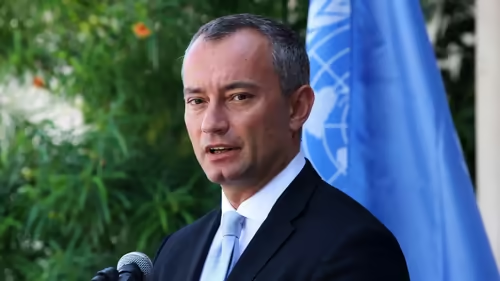
In one of the most volatile regions on Earth, where ceasefires often crumble within days, a new diplomatic figure has emerged with a mission that many consider near-impossible: turning a fragile truce in Gaza into a durable, lasting peace. That man is Nickolay Mladenov—a seasoned Bulgarian diplomat with deep experience in Middle Eastern affairs—and his appointment as the High Representative for Gaza marks a significant escalation in international efforts to stabilize the region .
But who exactly is Nickolay Mladenov, and why has he been entrusted with such a delicate and high-profile role? As global powers—including the United States, Israel, and various Palestinian factions—navigate a complex web of mistrust and historical grievances, Mladenov’s background, credibility, and past record may hold the key to whether this latest peace initiative succeeds or fails.
Table of Contents
- Who Is Nickolay Mladenov? A Diplomatic Profile
- The Nickolay Mladenov Gaza Mandate: What Does It Entail?
- His Crucial Tenure as UN Special Coordinator for the Middle East
- Why Was He Chosen for This Role?
- The Daunting Challenges Ahead
- Summary: A Bridge Between Enemies in a Fractured Land
- Sources
Who Is Nickolay Mladenov? A Diplomatic Profile
Born in Bulgaria in 1972, Nickolay Mladenov has built a distinguished career spanning national politics and international diplomacy. He served as Bulgaria’s Minister of Foreign Affairs and later as Minister of Defense before transitioning to the global stage. His big break came in 2015 when then-UN Secretary-General Ban Ki-moon appointed him as the Special Coordinator for the Middle East Peace Process and Personal Representative of the Secretary-General to the Palestine Liberation Organization (PLO) and the Palestinian Authority .
Fluent in English, Russian, and Bulgarian, Mladenov is known for his calm demeanor, pragmatic approach, and ability to engage with all sides—even during periods of intense conflict. His tenure at the UN was marked by relentless shuttle diplomacy between Ramallah, Jerusalem, Cairo, and New York, often during some of the region’s most violent escalations.
The Nickolay Mladenov Gaza Mandate: What Does It Entail?
Mladenov’s new role as High Representative for Gaza is not an official UN position but a U.S.-backed diplomatic initiative designed to create a neutral, trusted channel between warring parties. In this capacity, he acts as a bridge linking the United States, Israel, and Palestinian authorities—including both the Palestinian Authority in the West Bank and, critically, stakeholders in Gaza .
His core responsibilities include:
- Monitoring ceasefire compliance by all parties and reporting violations transparently.
- Facilitating humanitarian aid delivery to rebuild infrastructure and restore basic services in Gaza.
- Coordinating reconstruction efforts with international donors and regional actors like Egypt and Qatar.
- Building confidence-building measures to pave the way for longer-term political negotiations.
Essentially, Mladenov is being asked to do what few diplomats have managed: transform a temporary pause in violence into a sustainable framework for coexistence.
His Crucial Tenure as UN Special Coordinator for the Middle East
From 2015 to 2020, Mladenov was the UN’s top diplomat on the Israel-Palestine file. During this period, he navigated multiple crises, including the 2018–2019 Gaza border protests and the U.S. decision to recognize Jerusalem as Israel’s capital—a move that upended decades of diplomatic consensus .
Despite limited leverage, Mladenov consistently advocated for a two-state solution and warned against unilateral actions that could derail peace prospects. He earned respect from both Western capitals and Arab states for his even-handedness, though critics argue that the structural constraints of the UN system limited his actual impact. Still, his deep institutional knowledge and existing relationships make him uniquely positioned for his current mission.
Why Was He Chosen for This Role?
Several factors likely contributed to Mladenov’s selection:
- Neutrality: As a Bulgarian—a non-Arab, non-Western European nation—he is perceived as less biased than diplomats from traditional powers like the U.S. or UK.
- Trust from Multiple Sides: He has maintained working relationships with Israeli officials, Palestinian technocrats, and U.S. policymakers over many years.
- Experience in Crisis Management: His time at the UN involved managing flare-ups that could have spiraled into full-scale war.
- Technical Expertise: He understands the intricacies of aid delivery, border security, and governance in Gaza.
For more on how neutral mediators shape conflict resolution, see our feature on [INTERNAL_LINK:international-diplomacy-in-conflict-zones].
The Daunting Challenges Ahead
Mladenov’s mission faces immense obstacles. Hamas, which controls Gaza, remains designated as a terrorist organization by the U.S. and EU, complicating direct engagement. Meanwhile, hardliners in Israel oppose any deal that doesn’t include Hamas’s disarmament. On the Palestinian side, the rift between Hamas in Gaza and the Fatah-led Palestinian Authority in the West Bank undermines unified negotiation.
Moreover, public trust is low. Past ceasefires have collapsed, and civilians on both sides remain skeptical. According to the UN Office for the Coordination of Humanitarian Affairs (OCHA), over 2.3 million people in Gaza live under severe restrictions, with 80% dependent on aid—a reality that fuels desperation and instability .
Without tangible improvements in daily life—electricity, clean water, freedom of movement—any political agreement will lack legitimacy among ordinary Palestinians and Israelis alike.
Summary: A Bridge Between Enemies in a Fractured Land
The appointment of Nickolay Mladenov as High Representative for Gaza represents a last-ditch effort by the international community to salvage peace from the ashes of repeated failures. His deep experience, neutrality, and diplomatic finesse offer a glimmer of hope. Yet, the path forward is fraught with political minefields, historical trauma, and competing agendas. Whether Mladenov can succeed where so many have failed remains one of the most critical questions in global diplomacy today.