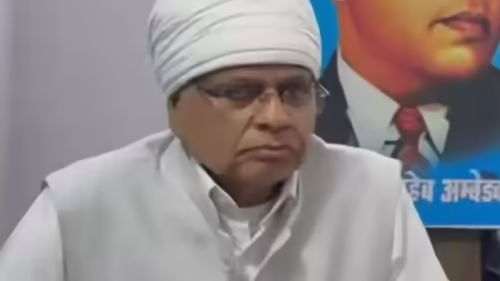
In a stunning display of misogyny that has sent shockwaves across India, a senior Congress legislator has made a series of deeply offensive and factually dangerous claims about rape, women’s appearance, and caste. The remarks, which have been widely condemned as archaic and harmful, have not only sparked a massive political row in Madhya Pradesh but have also forced the Congress party into damage control mode.
Table of Contents
- The Controversial Remarks That Started It All
- Deconstructing the Congress MLA’s ‘Rape Theory’
- The Political Firestorm and Public Outcry
- How the Congress Party is Trying to Contain the Damage
- Why These Remarks Matter Beyond Politics
- Summary: A Dangerous Narrative Rejected by the Nation
- Sources
The Controversial Remarks That Started It All
The controversy erupted after Congress MLA Phool Singh Baraiya from the Bhander constituency in Madhya Pradesh gave an interview where he attempted to explain the causes of rape in India. His explanation was not only scientifically baseless but also deeply insulting to women across the country .
Baraiya claimed that “on seeing a beautiful woman, one can get distracted,” implying a direct and dangerous link between a woman’s appearance and the likelihood of her being assaulted . This victim-blaming narrative is a well-known myth that has been repeatedly debunked by experts on gender-based violence.
Deconstructing the Congress MLA’s ‘Rape Theory’
The MLA’s so-called ‘rape theory’ didn’t stop at blaming victims for their appearance. He went on to make even more inflammatory and casteist remarks. He suggested that women from Scheduled Caste (SC), Scheduled Tribe (ST), and Other Backward Classes (OBC) communities are raped not because of their beauty, but due to interpretations of religious scriptures .
In perhaps his most disturbing comment, Baraiya used the term “teerth phal” (pilgrimage blessing), implying that raping a Dalit woman somehow provides a spiritual benefit to the perpetrator . This statement is not just offensive; it’s a horrifying reflection of the deep-seated caste prejudices that continue to plague parts of Indian society.
To summarize his dangerous assertions:
- Beauty as a Provocation: He stated that a “beautiful girl can distract any man,” suggesting men cannot control their urges .
- Caste-Based Justification: He claimed SC/ST/OBC women are targeted due to scriptural misinterpretations .
- Spiritual Reward Myth: He invoked the abhorrent concept of “teerth phal” in the context of raping Dalit women .
The Political Firestorm and Public Outcry
The backlash was swift and severe. Madhya Pradesh Chief Minister Mohan Yadav, from the rival BJP, led the charge, demanding a public apology from Congress leader Rahul Gandhi for the remarks made by his party’s MLA . The BJP has labeled the comments as “misogynistic and anti-Dalit” and is calling for Baraiya’s immediate expulsion from the legislative assembly .
Beyond the political grandstanding, the remarks have ignited a wave of anger among social activists, women’s rights groups, and ordinary citizens. Such statements from an elected representative are seen as a direct attack on the dignity and safety of all women, reinforcing harmful stereotypes that hinder progress on gender equality. For more on how political rhetoric impacts social issues, see our analysis on [INTERNAL_LINK:women-in-indian-politics].
How the Congress Party is Trying to Contain the Damage
Facing immense pressure, the Congress party has been quick to distance itself from Baraiya’s comments. In an official statement, the party declared that his views were “personal” and did not reflect the stance of the organization . This is a common crisis management tactic, but it raises questions about the vetting process for candidates and the internal culture within the party.
This incident is a significant setback for the Congress in Madhya Pradesh, where they are already in the opposition. It provides ample ammunition for the ruling BJP to paint the entire party with the same brush of regressive thinking. The party now faces the difficult task of rebuilding trust with its voter base, particularly among women and marginalized communities who feel directly targeted by these remarks.
Why These Remarks Matter Beyond Politics
While this is a political controversy, its implications are far more profound. Statements like those made by the MLA perpetuate a culture of victim-blaming that makes it harder for survivors of sexual assault to come forward. They shift the responsibility from the perpetrator to the victim, a narrative that is both false and damaging.
According to data from the National Crime Records Bureau (NCRB), the reasons for rape are complex and rooted in power, control, and societal structures—not a victim’s clothing or appearance. Promoting such myths from a position of authority is not just irresponsible; it’s dangerous.
Furthermore, linking caste to sexual violence in the manner Baraiya did serves to normalize and even justify horrific crimes against some of India’s most vulnerable populations. This is a direct affront to the constitutional values of equality and justice for all.
Summary: A Dangerous Narrative Rejected by the Nation
The Congress MLA rape theory controversy is a stark reminder of the persistent challenges India faces in combating misogyny and casteism, even within its highest democratic institutions. The remarks by Phool Singh Baraiya have been universally condemned as archaic, offensive, and factually incorrect. While the Congress party has distanced itself, the incident has triggered a necessary national conversation about the language used by our leaders and its real-world impact on the safety and dignity of millions of citizens. The demand for accountability is not just political; it’s a moral imperative for a progressive society.