Table of Contents
- A Pivotal Moment in Syria’s Conflict
- Why Tabqa is a Strategic Prize
- The Withdrawal of Kurdish Forces
- Local Reaction and the Road Ahead
- Broader Implications for the Region
- Conclusion: A New Chapter in Syria’s War?
A Pivotal Moment in Syria’s Conflict
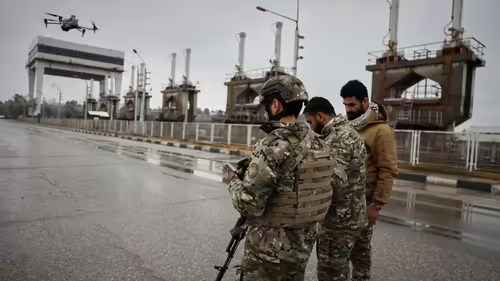
The long and brutal Syrian civil war has entered a new and potentially decisive phase. On January 18, 2026, the Syrian government announced it had successfully seized the strategic town of Tabqa in Raqqa province . This move is not just a territorial gain; it represents a major shift in the balance of power within the country and a bold reassertion of Damascus’s authority over key regions previously held by other factions.
The capture of Tabqa follows days of intense clashes and security operations as government troops pushed east of the Euphrates River, an area that has been a stronghold for Kurdish-led forces for years . The successful offensive marks a critical juncture in the Syrian government’s ongoing campaign to consolidate its control over the entire nation.
Why Tabqa is a Strategic Prize
Tabqa is far more than just another town on the map. Its value lies in two critical assets that are vital for any power seeking to control northern Syria.
- The Tabqa Dam: This massive structure on the Euphrates River is the largest dam in Syria. It regulates the southward flow of water, which is essential for agriculture, drinking water, and electricity generation for millions of people downstream. Controlling the dam gives the Syrian government immense leverage over the region’s most basic resources .
- Proximity to Oil Fields: The Tabqa area is also close to some of Syria’s largest and most productive oil fields. Securing this territory means the Damascus regime can now directly access and manage a significant portion of the country’s energy wealth, a crucial factor for its economic recovery and future stability .
The Withdrawal of Kurdish Forces
The Syrian army’s advance into Tabqa was made possible by the withdrawal of Kurdish forces, who had controlled the town for several years as part of their autonomous administration in northeastern Syria . The reasons behind this strategic retreat are complex and likely involve a combination of military pressure from Damascus and shifting geopolitical dynamics, particularly with their former allies.
This development raises serious questions about the future of the Kurdish-led autonomous project in Syria. The loss of such a critical town is a major blow to their territorial integrity and political ambitions. It signals a potential rollback of the gains they made during the chaos of the civil war and the fight against ISIS.
Local Reaction and the Road Ahead
Reports from the ground indicate a mixed but cautiously optimistic reaction from the local population. Many residents, weary after years of conflict and instability, have reportedly welcomed the arrival of Syrian government troops, seeing them as a force that could finally restore a sense of order and normalcy .
However, the road ahead is fraught with challenges. The Syrian government now faces the immense task of administering a region with a diverse ethnic and political makeup. Rebuilding trust, restoring essential services, and ensuring the security of all communities will be its immediate priorities. Any misstep could ignite new tensions and undermine the fragile peace it hopes to establish.
Broader Implications for the Region
The fall of Tabqa to Damascus has sent ripples across the Middle East and beyond. It is a clear signal of the Syrian government’s growing strength and its determination to re-establish its sovereignty over its entire territory. This shift could have significant consequences for the roles of external powers like the United States, Turkey, and Russia, all of whom have vested interests in the outcome of the Syrian conflict.
For the U.S., which has supported Kurdish forces in the past, this development represents a major setback to its influence in eastern Syria. It may force a reassessment of its regional strategy. Meanwhile, for allies of the Damascus regime, this victory is a validation of their support and a sign of their client’s resilience.
Conclusion: A New Chapter in Syria’s War?
The seizure of Tabqa by the Syrian government is a watershed moment. It is a powerful demonstration of Damascus’s renewed military and political momentum. While the war is far from over, this event marks a significant step towards the regime’s goal of full territorial control. The coming weeks and months will be critical in determining whether this victory can translate into lasting stability or if it will merely be a prelude to a new, more complex phase of the conflict. One thing is certain: the map of power in Syria has been redrawn, and the world is watching closely.
Sources
- Times of India: Tensions escalate in Syria: Damascus seizes Tabqa town; locals welcome Syrian troops
- BBC News: Syrian army seizes country’s largest oil field from Kurdish forces
- Reuters: Fighting intensifies in N. Syria as Kurdish forces face new offensive
- [INTERNAL_LINK:syria-civil-war-timeline]