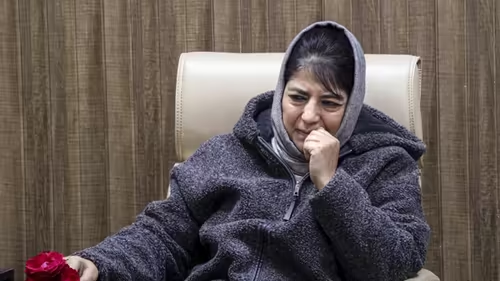
In a nation where art and politics often collide, a new flashpoint has emerged—not on a battlefield, but in the court of public opinion. Music maestro AR Rahman recently made headlines with a statement that many interpreted as a veiled critique of rising identity-based tensions in India. But it was former Jammu and Kashmir Chief Minister Mehbooba Mufti who turned the spotlight into a mirror, firing back with a searing response titled ‘Truth of India’—a phrase that has since gone viral across social media.
“Don’t speak about unity while ignoring the pain of millions,” Mufti wrote in a pointed social media post, directly addressing Rahman. Her message wasn’t just a rebuttal—it was a manifesto of lived experience, drawing attention to what she calls the ‘realities of Indian Muslims’ in an era marked by increasing polarization, surveillance, and marginalization .
Table of Contents
- What Did AR Rahman Actually Say?
- Mehbooba Mufti’s ‘Truth of India’ Rebuttal
- The ‘Realities of Indian Muslims’ She Cited
- Why This Clash Matters in Today’s India
- Public and Political Reactions
- Conclusion: Art, Accountability, and the Burden of Truth
- Sources
What Did AR Rahman Actually Say?
While Rahman did not name any specific group or policy, his recent interview included a line that sparked intense debate: “We must rise above religion and see ourselves as one people.” On the surface, it sounds like a call for harmony. But critics, including Mehbooba Mufti, argue that such statements—when made without acknowledging systemic injustices—ring hollow .
“When you say ‘rise above religion’ while Muslims are being detained without trial, their homes bulldozed, and their voices silenced, it’s not unity—it’s erasure,” Mufti countered. Her stance reflects a growing sentiment among minority communities who feel that calls for ‘apolitical harmony’ often serve to silence legitimate grievances.
Mehbooba Mufti’s ‘Truth of India’ Rebuttal
Mufti’s response was both personal and political. Drawing from her decades in public life—and her family’s tragic history (her father, Mufti Mohammad Sayeed, and brother, Tariq Hameed Karra, both faced political persecution)—she framed Rahman’s comment as emblematic of a privileged disconnect.
“The truth of India isn’t in hashtags or award shows,” she wrote. “It’s in the eyes of a mother in Bulandshahr whose son was lynched over rumors. It’s in the silence of students expelled for wearing hijabs. It’s in the fear of every Muslim child who wonders if their name will get them denied a job.”
She emphasized that true unity cannot be built on denial. “You can’t heal a wound by pretending it doesn’t bleed,” she added—a line that resonated deeply with thousands online .
The ‘Realities of Indian Muslims’ She Cited
Mufti didn’t stop at rhetoric. She listed concrete issues facing Indian Muslims today:
- Citizenship Anxiety: The fallout from the Citizenship Amendment Act (CAA) and National Register of Citizens (NRC) has left millions in legal limbo.
- Economic Marginalization: Muslims remain underrepresented in government jobs and formal sector employment despite comprising 14% of the population .
- Targeted Violence: Incidents of mob lynching, hate speech, and mosque demolitions have surged in recent years, with low conviction rates.
- Political Silencing: Parties representing Muslim interests face intense scrutiny, funding freezes, and even bans.
[INTERNAL_LINK:minority-rights-in-india] These aren’t hypotheticals—they’re documented trends backed by reports from organizations like the Sachar Committee and the Pew Research Center.
Why This Clash Matters in Today’s India
This exchange transcends celebrity gossip. It reflects a deeper national tension: Who gets to define India’s identity? Artists like Rahman, celebrated globally, often advocate for a sanitized, inclusive vision. But leaders like Mufti—rooted in ground-level politics—argue that inclusion without justice is performative.
In Kashmir, where Mufti’s influence remains strong, such debates carry extra weight. With the region still under heavy security and political restrictions post-2019, her voice represents a constituency that feels increasingly invisible in mainstream discourse.
Public and Political Reactions
The reaction has been polarized. Progressive activists and civil society groups praised Mufti for “speaking truth to power.” Meanwhile, right-wing commentators accused her of “playing victim politics” and “dividing the nation.”
Rahman has not issued a formal response, though sources close to him say he “never intended to dismiss anyone’s pain” and believes “music is a bridge, not a battleground.” Yet, the damage—or dialogue—has already begun.
Conclusion: Art, Accountability, and the Burden of Truth
Mehbooba Mufti’s intervention is a reminder that in a democracy, even well-intentioned messages must be scrutinized through the lens of equity. Rahman’s call for unity is noble—but unity without acknowledgment of injustice is fragile.
As India navigates its complex pluralism, voices like Mufti’s—raw, unfiltered, and rooted in struggle—serve as necessary counterweights to polished narratives. The ‘truth of India’ may be uncomfortable, but it’s the only foundation on which lasting peace can be built.