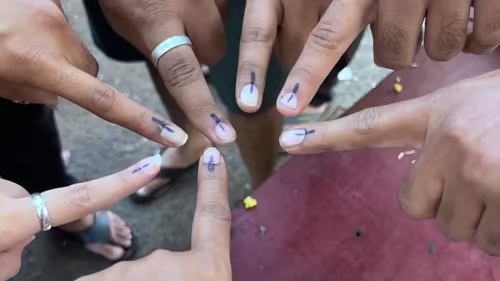
In a stunning reversal that underscores growing concerns over electoral integrity, the State Election Commission (SEC) has scrapped the use of marker pens for applying indelible ink on voters’ fingers—returning instead to the time-tested bottled version. This decision comes after a firestorm of criticism erupted when viral videos from recent municipal elections in Maharashtra showed poll ink being effortlessly wiped off with common household substances like lemon juice and nail polish remover .
The controversy wasn’t just about smudged fingers—it was about the very foundation of democracy. If a voter’s mark can be erased, they can vote multiple times. And if that’s possible, the entire election result becomes suspect. Faced with mounting public outrage and demands for accountability, the SEC has adopted what it calls a “cautious approach” to safeguard the sanctity of the ballot box .
Table of Contents
- The Marker Pen Controversy That Shook Public Trust
- Why Bottled Indelible Ink Has Been India’s Gold Standard
- How Erasable Ink Enabled Potential Bogus Voting
- SEC’s Damage Control: A Return to Proven Methods
- Broader Implications for Electoral Security in India
- Conclusion: Trust Must Be Earned, Not Assumed
- Sources
The Marker Pen Controversy That Shook Public Trust
During the recent corporation elections in Pune and other Maharashtra cities, polling officials were seen using felt-tip marker pens—marketed as “indelible”—to mark voters’ left index fingers. Within hours, social media exploded with videos demonstrating how these marks could be removed in seconds using simple solvents .
One widely shared clip showed a man voting in the morning, washing his finger with soap and vinegar by noon, and successfully casting a second ballot in the afternoon. While unverified, such footage fueled widespread panic and accusations of systemic vulnerability. Political parties across the spectrum demanded an immediate investigation, calling the incident a “direct threat to democracy” .
Why Bottled Indelible Ink Has Been India’s Gold Standard
For over six decades, India’s electoral system has relied on a special violet-colored indelible ink developed by the National Physical Laboratory (NPL) in 1952. This ink, applied via a small glass bottle with a metal applicator, contains silver nitrate—a compound that reacts with skin proteins to leave a stain that lasts 7–14 days and cannot be removed by soap, alcohol, or solvents .
Its reliability has made it a global benchmark. Over 30 countries, including Canada, South Africa, and Indonesia, import India’s Mysore Paints & Varnish Limited (MPVL)—the sole authorized manufacturer—precisely because of its tamper-proof nature .
[INTERNAL_LINK:history-of-indian-elections] The shift to marker pens, reportedly driven by convenience and cost-cutting, ignored this legacy of scientific rigor—and the consequences were swift and severe.
How Erasable Ink Enabled Potential Bogus Voting
The flaw in the marker pens wasn’t just technical—it was strategic. Unlike the NPL-formulated bottled ink, many commercial markers used dyes that sit on the skin’s surface rather than bonding chemically. This made them vulnerable to:
- Chemical removal: Acetone, lemon juice, and even hand sanitizers could erase the mark.
- Rapid fading: Some marks vanished within hours under sunlight or sweat.
- Counterfeiting: Fake ink pens could be distributed to enable coordinated multiple voting.
In close municipal races—where victories are often decided by a few hundred votes—the potential for manipulation was enormous. Election observers noted that in at least three wards in Pune, voter turnout exceeded 100% of registered electors, raising red flags about duplicate voting .
SEC’s Damage Control: A Return to Proven Methods
Acting swiftly, the Maharashtra State Election Commission announced it would revert to the traditional bottled indelible ink supplied exclusively by MPVL for all upcoming zilla parishad and panchayat elections .
“The use of marker pens was an experiment that failed to meet our security standards,” said a senior SEC official. “We are adopting a cautious approach to ensure that every vote counts—and is counted only once.”
The commission also ordered a full audit of the procurement process that approved the markers and mandated retraining for all polling personnel on proper ink application protocols.
Broader Implications for Electoral Security in India
This incident is a wake-up call beyond Maharashtra. It highlights a dangerous trend: the prioritization of administrative convenience over electoral integrity. As India prepares for state assembly elections in 2026 and the 2029 Lok Sabha polls, ensuring foolproof voter identification is non-negotiable.
Experts argue that while EVMs have reduced booth capturing, vulnerabilities now lie in pre-poll processes like voter marking. Strengthening these “analog safeguards” is just as critical as securing digital systems .
Conclusion: Trust Must Be Earned, Not Assumed
The indelible ink scandal may seem like a small detail, but in democracy, details matter. A voter’s mark is more than a stain—it’s a symbol of their irreplaceable voice. By reverting to the scientifically validated bottled ink, the SEC has taken a vital step toward restoring that trust.
Yet, the real lesson is deeper: electoral innovation must never compromise core principles. In the race for efficiency, we must never lose sight of integrity. Because when the ink fades, so does faith—in the system, in the process, and in democracy itself.