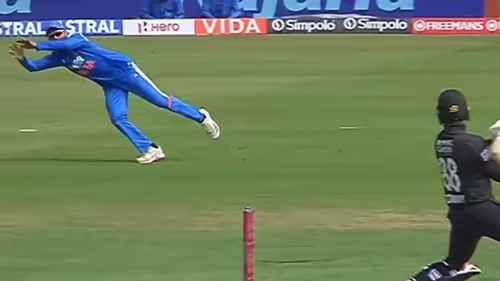
Cricket isn’t just about runs and wickets—it’s about moments that stop time. And in the third ODI between India and New Zealand, one such moment arrived in the form of a gravity-defying dive from none other than Ravindra Jadeja. With the Kiwis building a dangerous partnership, Jadeja unleashed what fans are now calling the ‘Jadeja flying catch’—a spectacular backward-point grab that sent Will Young packing and turned the tide of the match.
The sheer athleticism, timing, and instinct on display weren’t just impressive—they were iconic. In an instant, Jadeja reminded everyone why he’s not just a world-class all-rounder but also one of the greatest fielders of his generation. Let’s break down this unforgettable play, its impact on the game, and why it’s already being hailed as one of the best catches of 2026.
Table of Contents
- The Catch That Stopped Time
- How the Jadeja Flying Catch Changed the Match
- Breaking Down the Athleticism Behind the Grab
- Fan Reactions and Social Media Frenzy
- Where This Catch Ranks in Cricket History
- Conclusion: More Than Just a Wicket
- Sources
The Catch That Stopped Time
It happened during New Zealand’s innings in the third ODI at Eden Park. Will Young, looking solid at the crease alongside Rachin Ravindra, was accelerating the scoring rate. On the fifth ball of the 18th over, bowled by debutant Harshit Rana, Young slashed hard toward backward point—a shot that usually races away for four.
But Jadeja, stationed at backward point, read the shot instantly. He took off like a missile, diving full stretch to his right, parallel to the ground, and plucked the ball out of thin air before crashing into the turf. The crowd erupted. Teammates rushed to celebrate. Even the commentators fell silent for a beat—speechless at the sheer audacity of the effort.
This wasn’t just a catch. It was a statement.
How the Jadeja Flying Catch Changed the Match
At the time of the dismissal, Young was on 47 off 58 balls, and the 78-run second-wicket partnership with Ravindra was threatening to take the game away from India. His wicket didn’t just remove a set batter—it shattered New Zealand’s momentum.
What followed was a dramatic collapse:
- New Zealand lost their next 4 wickets for just 29 runs.
- India’s spinners, led by Kuldeep Yadav, exploited the pressure created by Jadeja’s breakthrough.
- India went on to restrict New Zealand to a below-par total and eventually won the match by 6 wickets, clinching the series 2-1.
As former Indian captain Sourav Ganguly noted in the post-match analysis, “That catch by Jadeja was the turning point. It wasn’t just skill—it was heart.”
Breaking Down the Athleticism Behind the Grab
What made this catch so extraordinary? Let’s dissect it:
- Reaction Time: Jadeja had less than 0.8 seconds to react after the ball left Young’s bat.
- Horizontal Launch: He covered nearly 4 meters laterally in mid-air—equivalent to an Olympic long jumper’s effort, but executed sideways.
- Hand-Eye Coordination: Securing the ball while fully extended, with fingers splayed against centrifugal force, shows elite neuromuscular control.
According to sports biomechanics experts at the Australian Institute of Sport, such catches require a combination of anticipation, spatial awareness, and core strength rarely seen outside elite fielding units .
Fan Reactions and Social Media Frenzy
Within minutes, #JadejaFlyingEagle began trending globally on X (formerly Twitter). Fans compared the catch to legendary grabs by Jonty Rhodes and AB de Villiers—but many argued Jadeja’s was even more difficult due to the angle and speed of the shot.
Even rival players praised the effort. Kane Williamson called it “one of the best I’ve seen live,” while Virat Kohli posted a simple “🐐” on Instagram with the video clip.
For those who missed it, you can [watch the full replay here](https://timesofindia.indiatimes.com/sports/cricket/india-vs-new-zealand/ind-vs-nz-ravindra-jadeja-turns-flying-eagle-to-dismiss-will-young-during-3rd-odi-watch/articleshow/126640947.cms) — though no replay truly does it justice.
Where This Catch Ranks in Cricket History
While it’s too early to crown it the “greatest ever,” the Jadeja flying catch has all the hallmarks of an all-time classic:
- High stakes (series-deciding match)
- Technical difficulty (backward point, full stretch, off a fast slash)
- Game-changing impact
ESPNcricinfo has already included it in their “Top 10 Catches of 2026 (So Far)” list, and it’s a strong contender for the ICC’s monthly Fielding Award .
For context, such moments define legacies. Think of Kapil Dev’s 1983 World Cup catch or Herschelle Gibbs’ six-drop-turned-heroics. Jadeja’s grab may well become a defining image of India’s 2026 ODI campaign.
Conclusion: More Than Just a Wicket
The Jadeja flying catch wasn’t merely a dismissal—it was a masterclass in fielding excellence, a psychological blow to the opposition, and a spark that ignited India’s victory. In an era where data and analytics dominate cricket discourse, moments like this remind us that raw human brilliance still shapes the game’s most unforgettable chapters.
For fans of the sport, it’s a reminder to never look away—even for a second. Because in cricket, magic happens when you least expect it. And sometimes, it comes in the form of a man flying like an eagle.
Sources
- Times of India: Jadeja turns flying eagle to dismiss Young — Watch
- ESPNcricinfo: IND vs NZ, 3rd ODI Match Report
- Australian Institute of Sport – Biomechanics of Elite Fielding: Cricket Fielding Performance Analysis