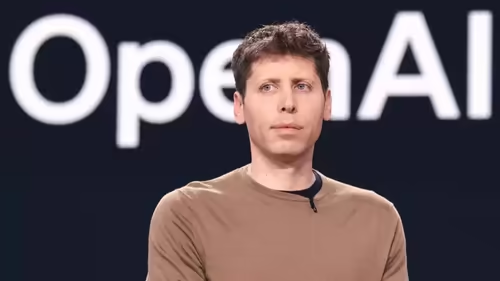
The AI gold rush has entered a new, cutthroat phase. Forget just building the best models; the real battle is for the brilliant minds who create them. And in this high-stakes game, OpenAI CEO Sam Altman has just played a masterstroke—or a ruthless power move—that’s left one of his most formidable new competitors reeling.
Just over a year after her high-profile departure from OpenAI, former CTO Mira Murati’s new venture, Thinking Machines Lab, is facing a crisis of confidence. In a dramatic series of events, OpenAI has successfully executed a major OpenAI talent raid, convincing three of Thinking Machines’ core founding members to return to their old stomping grounds . This isn’t just a poaching; it’s a strategic dismantling of a rival at its most vulnerable stage.
Table of Contents
- The Thinking Machines Exodus
- Sam Altman’s Aggressive Hiring Playbook
- Why This OpenAI Talent Raid is a Game-Changer
- The Future of Thinking Machines Lab
- Conclusion: The Human Cost of the AI Race
- Sources
The Thinking Machines Exodus
Launched in early 2025 with a record-shattering $2 billion in seed funding and an initial $12 billion valuation, Thinking Machines Lab was heralded as a potential OpenAI killer . Co-founded by Murati alongside former OpenAI heavyweights Barret Zoph and Luke Metz, the company promised to build powerful, safe AI systems with a fresh perspective .
However, the dream is already showing serious cracks. In a stunning turn, both co-founders Barret Zoph and Luke Metz, along with another key founding team member, Sam Schoenholz, have all returned to OpenAI . The situation was so dire that Murati was forced to publicly announce the termination of Zoph, who was serving as CTO, and replace him with Soumith Chintala . This wasn’t a graceful exit; it was a full-blown leadership shakeup triggered by a mass defection .
This wave of departures comes at a critical juncture. Reports suggest Thinking Machines was in talks to raise a massive new round of funding that would have valued the company at a staggering $50-$60 billion [[11], [13]]. Such ambitious plans now seem precarious, as investor confidence is directly tied to the stability and expertise of the founding team. A talent exodus of this magnitude is a major red flag for any venture capitalist .
Sam Altman’s Aggressive Hiring Playbook
This move is a textbook example of Sam Altman’s aggressive, almost Zuckerberg-esque, hiring strategy. When faced with a threat, don’t just compete; absorb it. By bringing Zoph, Metz, and Schoenholz back into the fold, OpenAI isn’t just gaining talent; it’s simultaneously weakening a direct competitor and reclaiming institutional knowledge that had walked out the door .
It’s a stark reminder of the immense power wielded by established tech giants in the AI space. They can offer resources, scale, and a platform that even a well-funded startup like Thinking Machines struggles to match. The lure of working on the world’s most advanced models at OpenAI, combined with likely lucrative compensation packages, proved too strong for the founders to resist .
Why This OpenAI Talent Raid is a Game-Changer
This isn’t just gossip from Silicon Valley; it has significant implications for the entire AI landscape:
- Consolidation of Power: It reinforces OpenAI’s dominant position, making it even harder for new entrants to challenge its lead. The barrier to entry isn’t just capital; it’s access to top-tier AI researchers, a pool that is now being aggressively guarded.
- Startup Vulnerability: It exposes a critical vulnerability for AI startups. Even with billions in the bank and a visionary leader like Murati, they remain fragile ecosystems highly dependent on their core team. A single, coordinated OpenAI talent raid can destabilize them overnight.
- The Personal Stakes: There’s an undeniable personal dimension to this story. Murati, once a central figure at OpenAI, is now watching her new creation be picked apart by her former colleagues. It adds a layer of drama to the already intense competition .
The Future of Thinking Machines Lab
So, what’s next for Thinking Machines? The path forward is fraught with challenges. Murati must now rebuild trust with her remaining team and, more importantly, with her investors. She needs to demonstrate that the company’s vision is still intact and that it can deliver on its promises without its original technical leadership trio.
Her appointment of Soumith Chintala, a respected figure in the AI community known for his work on PyTorch, is a smart defensive move . It signals a commitment to technical excellence. However, the damage to morale and market perception may be difficult to repair. The company’s ability to secure its next round of funding at the desired $50B+ valuation now seems highly uncertain .
For other startups in the space, this serves as a cautionary tale. The competition isn’t just about algorithms and data; it’s a relentless war for human capital. As we’ve seen in our analysis of the [INTERNAL_LINK:ai-startup-funding-landscape], a strong team is the single most valuable asset.
Conclusion: The Human Cost of the AI Race
The saga of Thinking Machines Lab is a powerful illustration of the brutal realities of the AI industry. While the public narrative focuses on model benchmarks and product launches, the real battles are fought in private negotiations and recruitment emails. Sam Altman’s successful OpenAI talent raid has not only dealt a severe blow to a promising competitor but has also sent a clear message to the entire field: in the race for AI supremacy, no one is safe, and loyalty is a luxury few can afford. The future of AI innovation may depend less on who has the best ideas and more on who can keep their best people.
Sources
- Times of India: Facing one of its ‘worst crisis’, OpenAI CEO Sam Altman does a Mark Zuckerberg kind of hiring
- Bloomberg: Former OpenAI CTO’s $12B AI Startup Is Already Losing Co-Founders
- MLQ.ai: Thinking Machines Lab Co-Founders Depart for OpenAI Return Amid Leadership Shakeup
- MIT Technology Review: Murati’s Thinking Machines in funding talks at $50 billion valuation