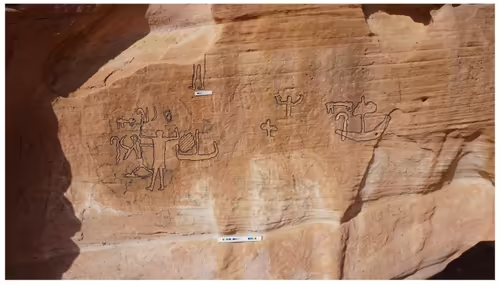
For decades, historians believed the early Egyptian state was largely confined to the fertile banks of the Nile. But a stunning new discovery is forcing us to rewrite the history books. Deep in the harsh terrain of the Sinai Desert, archaeologists have uncovered a 5,000-year-old rock carving that serves as a chilling and powerful declaration of ancient Egypt’s reach and ambition—a message carved in stone that says, “This land is ours.”
Table of Contents
- The Discovery: A Chilling Message from the Past
- Decoding the 5,000-Year-Old Rock Carving
- Why Sinai Mattered to Ancient Egypt
- A New Understanding of Early Egyptian Dominance
- Conclusion: Rewriting the Narrative of Empire
- Sources
The Discovery: A Chilling Message from the Past
The discovery was made by a team led by Professor Ludwig Morenz of the University of Bonn in the remote Wadi Khamila region of the Sinai Peninsula [[5]]. What they found wasn’t just a simple piece of ancient art; it was a sophisticated and deliberate political statement. This 5,000-year-old rock carving is now being hailed as one of the earliest known examples of a visual claim to colonial power in human history [[4]].
The panel depicts scenes of violence and subjugation, showing bound captives and a dominant figure, interpreted by experts as a representation of the Egyptian state or its deity. It’s a stark, terrifying image that leaves no room for ambiguity about who was in control [[2]]. This wasn’t just a record of an event; it was a warning and a proclamation meant to be seen by anyone who dared to challenge Egyptian authority in this crucial territory.
Decoding the 5,000-Year-Old Rock Carving
Professor Morenz and his team have spent months meticulously analyzing the intricate details of the carving. Their research suggests the central figure may be an early depiction of the god Min, a deity associated with fertility, power, and male virility [[7]]. By linking their military and political dominance to a powerful god, the Egyptians were not just claiming the land; they were sanctifying their conquest, giving it a divine mandate.
The inscription also includes early hieroglyphic symbols, providing invaluable context for linguists studying the evolution of the Egyptian writing system. The combination of image and text creates a multi-layered message of power, resource control, and religious justification that is remarkably sophisticated for its time [[9]].
Why Sinai Mattered to Ancient Egypt
The location of this discovery is key to understanding its significance. The Sinai Peninsula was not a barren wasteland to the ancient Egyptians; it was a treasure trove. It was the primary source of two of their most critical resources:
- Copper: Essential for making tools, weapons, and ornaments.
- Turquoise: A highly prized gemstone used in elite jewelry and religious artifacts.
Controlling these mines was a matter of national security and economic prosperity. The 5,000-year-old rock carving served as a permanent marker, staking Egypt’s claim to these vital assets and deterring rival groups or nomadic tribes from interfering with their mining expeditions [[9]]. It’s a brilliant, if brutal, strategy of resource management and territorial control.
A New Understanding of Early Egyptian Dominance
This discovery fundamentally shifts our perspective on the early Egyptian state. Previously, scholars viewed its expansion as a gradual process that happened centuries later. This carving proves that the mechanisms of empire—military force, symbolic propaganda, and resource exploitation—were already in place at the very dawn of Pharaonic civilization [[1]].
It shows that Egypt’s vision of itself as a dominant power extended far beyond its agricultural heartland much earlier than previously thought. This wasn’t just a kingdom protecting its borders; it was an emerging empire projecting its will into foreign lands. For more on how ancient empires managed their territories, see our analysis on [INTERNAL_LINK:ancient-empire-strategies].
The find also offers a sobering reminder that the drive for power and control is a deeply ingrained part of human history. As one expert noted, the carving depicts a “terrifying brutality” that underscores the violent foundations of early state formation [[2]].
Conclusion: Rewriting the Narrative of Empire
The 5,000-year-old rock carving in Sinai is far more than an archaeological curiosity. It’s a revolutionary piece of evidence that rewrites our understanding of ancient Egypt’s geopolitical reach. It demonstrates that the blueprint for empire was drawn up in the desert sands of Sinai over five millennia ago, using a potent mix of military might, religious symbolism, and economic necessity. This discovery doesn’t just add a new chapter to history; it forces us to start reading from a different page altogether.
Sources
- Indian Defence Review: 5000-Year Warning Message from Ancient Egypt [[1]]
- ZME Science: A 5000-Year-Old Inscription Reveals the Terrifying Brutality [[2]]
- University of Bonn: Spectacular discovery in the Sinai [[5]]
- Ancient Origins: Spectacular Sinai Find Shows Early Egyptian Colonial Power [[7]]
- Archaeology Magazine: Rock Art in Sinai Shows Early Egyptian Conquest [[9]]