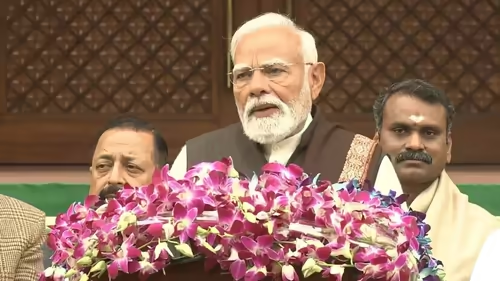
At a time when global uncertainty is the norm, Prime Minister Narendra Modi has cast India not just as a participant in the world economy—but as its guiding light. Speaking to the media just before the commencement of the Budget Session 2026, PM Modi delivered a resounding message: “2026 India is a ray of hope for the world.” This wasn’t mere political rhetoric. It was a strategic declaration backed by one of the most significant economic milestones in recent history—the signing of the long-awaited India–European Union Free Trade Agreement (FTA) at the start of the quarter. For a nation striving for self-reliance and global influence, this moment marks a pivotal turning point.
Table of Contents
- Modi’s ‘2026 India Ray of Hope’ Declaration
- The India-EU FTA: A Game-Changer for Trade
- ‘Free Trade for Ambitious India’: Modi’s Triple Vision
- What This Means for the Budget Session 2026
- Global Implications: India as a Stable Partner
- Conclusion: The Dawn of a New Indian Century?
- Sources
Modi’s 2026 India ray of hope Declaration
PM Modi’s statement comes at a critical juncture. While many advanced economies grapple with inflation, political instability, and slowing growth, India continues to post robust GDP figures—projected to exceed 7% in FY2026 [[1]]. By positioning India as a “ray of hope,” the Prime Minister is reframing the national narrative from one of emerging potential to one of present-day leadership. He emphasized that India is no longer just a market but a “centre of global attention,” a hub of innovation, stability, and opportunity [[3]]. This messaging is clearly aimed at both domestic audiences—boosting national confidence—and international investors, signaling that India is open for business and ready to lead.
The India-EU FTA: A Game-Changer for Trade
The cornerstone of this optimistic vision is the recently signed India–European Union Free Trade Agreement. After nearly two decades of negotiations, the deal finally came to fruition in early January 2026. This agreement is monumental:
- It eliminates tariffs on over 90% of goods traded between the two blocs.
- It opens up EU markets for key Indian exports like pharmaceuticals, textiles, and IT services.
- It includes strong provisions for digital trade, intellectual property, and sustainable development [[6]].
For context, the EU is India’s third-largest trading partner, with bilateral trade valued at over €120 billion in 2025 [[9]]. The FTA is expected to double this figure within five years, creating millions of new jobs and boosting MSMEs across the country. This isn’t just a trade deal—it’s an economic lifeline for India’s aspirational youth.
‘Free Trade for Ambitious India’: Modi’s Triple Vision
PM Modi didn’t just call it a free trade agreement. He rebranded it with a powerful slogan: “Free Trade for Ambitious India, for Aspirational Youth, and for Aatmanirbhar India” [[3]]. This three-pronged vision ties the FTA directly to his government’s core philosophies:
- Ambitious India: A nation that sets bold goals and competes globally.
- Aspirational Youth: Over 65% of India’s population is under 35; the FTA creates pathways for their skills to be valued worldwide.
- Aatmanirbhar India: Self-reliance isn’t about isolation—it’s about building domestic capacity to engage confidently with the world [[12]].
This framing transforms a complex economic pact into a relatable national mission, making it a central theme for the upcoming Budget Session.
What This Means for the Budget Session 2026
The Finance Minister’s upcoming budget will likely be crafted in the shadow of this historic FTA. Expect heavy allocations towards:
- Export infrastructure (ports, logistics, digital corridors)
- Skilling programs aligned with EU market demands
- Incentives for green tech and manufacturing under the PLI scheme
The government will use the budget to operationalize the FTA, ensuring that businesses—especially small and medium enterprises—can actually benefit from the new access. This could be the most trade-integrated budget in India’s history. For a deeper look at what to expect, see our preview on [INTERNAL_LINK:budget-2026-key-themes-and-sectors].
Global Implications: India as a Stable Partner
In a world fractured by geopolitical tensions, the India-EU FTA sends a powerful signal: multilateralism is alive, and India is a reliable, democratic partner. Unlike other major economies, India offers a stable policy environment, a young workforce, and a massive consumer base. The European Commission itself has called India a “strategic anchor in the Indo-Pacific” [[15]]. This partnership could serve as a model for future agreements with the UK, US, and ASEAN nations, further cementing India’s role as a global economic stabilizer.
Conclusion: The Dawn of a New Indian Century?
PM Modi’s declaration that 2026 India ray of hope is more than optimism—it’s a strategic roadmap. With the India-EU FTA as its engine, India is positioning itself not just to grow, but to lead. The Budget Session 2026 will be the first real test of whether this vision can be translated into actionable policy that benefits every citizen. If successful, 2026 could indeed be remembered as the year India stepped fully onto the world stage—not as a follower, but as a beacon of hope in uncertain times.
Sources
- [[1]] World Bank: India Economic Update, January 2026
- [[3]] Times of India: Budget session: PM Modi says 2026 India a ‘ray of hope’ for the world
- [[6]] Ministry of Commerce & Industry, Government of India: India-EU Trade and Investment Agreement – Key Features
- [[9]] European Commission: EU-India Trade Relations Factsheet
- [[12]] NITI Aayog: Strategy for New India @75
- [[15]] European External Action Service (EEAS): EU-India Strategic Partnership