Table of Contents
- Introduction: The 2026 Celestial Grand Slam
- 2026 Eclipse Calendar at a Glance
- February 17: The Elusive ‘Ring of Fire’
- March 2–3: The Dramatic Blood Moon
- August 12: Total Solar Eclipse Over Europe
- August 27–28: A Subtle Partial Lunar Eclipse
- How to Safely Enjoy the 2026 Eclipses
- Bonus: Planetary Alignments in 2026
- Conclusion: Your 2026 Stargazing Checklist
- Sources
Introduction: The 2026 Celestial Grand Slam
If you’re a skywatcher—or even just someone who loves a good cosmic show—2026 is your year. Forget fireworks; the heavens are rolling out a spectacular lineup of eclipses that includes a mystical ring of fire, a vivid blood moon, and a jaw-dropping total solar eclipse that will sweep across mainland Europe. This isn’t just a series of events; it’s a celestial grand slam.
In this guide, we’ll walk you through the complete 2026 eclipse calendar, with exact dates, visibility zones, and viewing tips so you don’t miss a single second of awe. Whether you’re planning a trip to Iceland or watching from your backyard in Mumbai, this is your ultimate eclipse roadmap.
2026 Eclipse Calendar at a Glance
2026 features four major eclipses: two solar and two lunar. Here’s the quick rundown:
- February 17, 2026: Annular Solar Eclipse (“Ring of Fire”) – visible primarily from Antarctica .
- March 2–3, 2026: Total Lunar Eclipse (“Blood Moon”) – visible across the Americas, Asia, and Australia .
- August 12, 2026: Total Solar Eclipse – path of totality crosses Greenland, Iceland, Spain, and parts of Russia .
- August 27–28, 2026: Partial Lunar Eclipse – visible from Europe, Africa, Asia, and Australia .
February 17: The Elusive ‘Ring of Fire’
The year kicks off with an annular solar eclipse—often called the “ring of fire”—on February 17, 2026. During this event, the Moon covers the Sun’s center, leaving its outer edges visible as a brilliant ring .
Unfortunately for most, the path of annularity is almost entirely over Antarctica, making it one of the least accessible eclipses of the decade . A partial eclipse will be visible across parts of southern Africa and South America, but the full “ring” will require a scientific expedition or a very adventurous cruise .
March 2–3: The Dramatic Blood Moon
Just two weeks later, the skies deliver a much more accessible spectacle: a blood moon. On the night of March 2–3, 2026, a total lunar eclipse will bathe the Moon in a deep coppery red for nearly an hour .
This happens because Earth’s atmosphere bends sunlight, filtering out blue light and projecting red light onto the Moon’s surface. Best viewing locations include North and South America, the Pacific, Eastern Asia, and Australia . Unlike solar eclipses, lunar eclipses are safe to watch with the naked eye—no special glasses needed!
August 12: Total Solar Eclipse Over Europe
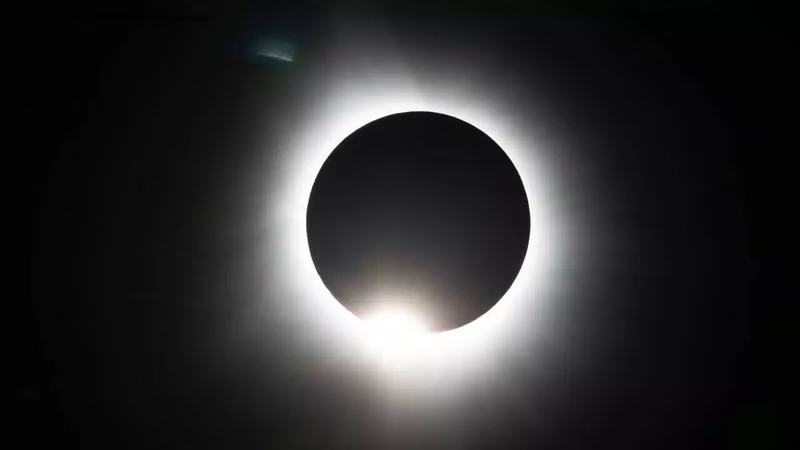
The crown jewel of the 2026 eclipse calendar arrives on August 12. A total solar eclipse will plunge parts of Europe into temporary darkness, with totality lasting up to **2 minutes and 18 seconds** .
The path of totality will sweep across:
- Western Greenland
- Iceland (including Reykjavik)
- Northern Spain (including cities like Burgos)
- A sliver of northern Portugal
- Northwestern Russia
A partial eclipse will be visible across the rest of Europe, North Africa, and the Middle East . If you’re in Europe, this is a once-in-a-generation opportunity—don’t miss it.
August 27–28: A Subtle Partial Lunar Eclipse
Rounding out the year is a partial lunar eclipse on August 27–28, 2026. Only a small portion of the Moon will pass through Earth’s umbral shadow, so the effect will be subtle—more of a shading than a dramatic color change .
Still, it’s worth a glance if you’re in Europe, Africa, Asia, or Australia. It’s a quiet epilogue to an otherwise action-packed eclipse year.
How to Safely Enjoy the 2026 Eclipses
Remember: never look directly at the Sun during a solar eclipse without certified eye protection. Regular sunglasses won’t cut it. Use ISO 12312-2–compliant solar eclipse glasses [[INTERNAL_LINK:solar-eclipse-safety-guide]].
For lunar eclipses like the blood moon? Enjoy freely! Grab a blanket, a hot drink, and enjoy the show.
Bonus: Planetary Alignments in 2026
Beyond eclipses, 2026 offers stunning planetary conjunctions. Keep an eye out for a close Jupiter-Saturn pairing in late February and a brilliant Venus-Mars meetup in May. These events are perfect for amateur astrophotographers and casual observers alike [[INTERNAL_LINK:best-planetary-alignments-2026]].
Conclusion: Your 2026 Stargazing Checklist
The 2026 eclipse calendar is packed with rare and breathtaking events. From the remote “ring of fire” to Europe’s total solar eclipse, there’s something for everyone—if you plan ahead. Mark your calendars, book your travel early (especially for August 12!), and prepare to witness some of the most awe-inspiring moments the cosmos has to offer.
Sources
- Time and Date – “Solar & Lunar Eclipse Dates 2026”
- EclipseWise – “Eclipse Maps: February 17, 2026”
- Forbes – “2026 Will Bring A ‘Blood Moon,’ ‘Ring Of Fire’ And Total Solar Eclipse”
- Time and Date – “Future Eclipses”
- Space.com – “Total solar eclipse 2026 – Everything you need to know”
- Time and Date – “Future Eclipses”
- Forbes – “2026 Will Bring A ‘Blood Moon,’ ‘Ring Of Fire’ And Total Solar Eclipse”
- Time and Date – “March 2–3, 2026 Total Lunar Eclipse”
- NASA – “NASA Confirms Date and Visibility of the First Solar Eclipse in 2026”
- Time and Date – “Solar & Lunar Eclipse Dates 2026”
- NASA Eclipse Website – Official U.S. government resource for eclipse data