Why India’s 2026 Budget Is Making History—On a Sunday
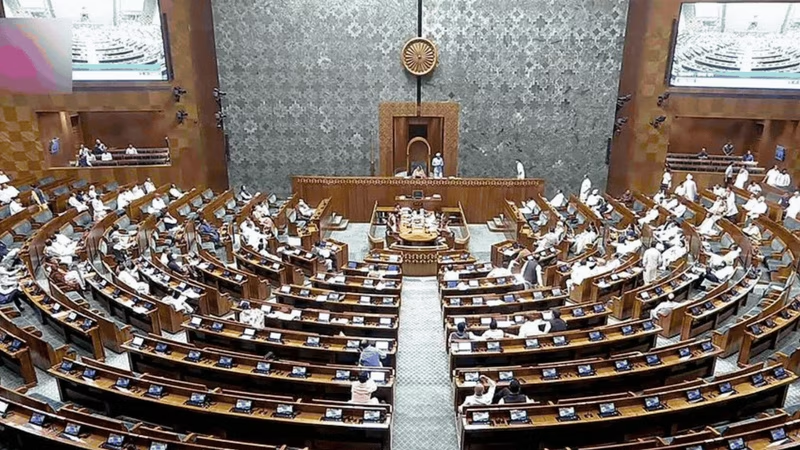
For over seven decades, India’s Union Budget has followed a predictable rhythm: presented on a late February weekday, steeped in colonial-era protocol, and wrapped in parliamentary formality. But in 2026, all that changes. The government has confirmed that the 2026 budget will be presented on **Sunday, February 1**—a move that is not just symbolic, but seismic.
This isn’t just about convenience or calendar quirks. It’s a deliberate signal that India is reimagining its fiscal identity—shedding outdated norms and embracing a new mantra: “reform, perform, and transform.” As the world grapples with inflation, geopolitical tensions, and supply chain volatility, India’s budget timing may be its quiet declaration of self-reliance and modernity.
Table of Contents
- Why a Sunday Budget Is Historic
- Timeline of the 2026 Budget Session
- The Theme: ‘Reform, Perform, Transform’
- Breaking Colonial Legacies in Fiscal Policy
- Market and Public Reaction
- What to Expect in the 2026 Budget
- Conclusion: A New Era of Fiscal Sovereignty
- Sources
Why a Sunday Budget Is Historic
Since India’s first budget in 1950, every Union Budget has been presented on a weekday—typically the last working day of February. The choice wasn’t arbitrary. It mirrored British parliamentary tradition, where budgets were delivered in the House of Commons during regular sitting days.
Presenting the 2026 budget on a Sunday shatters that 76-year precedent. Sundays are non-sitting days for Parliament, meaning the actual debate will begin on Monday, February 2. But the symbolic weight is immense: it’s a clear message that India is no longer bound by inherited systems.
“This is more than scheduling—it’s sovereignty,” says Dr. Priya Mehta, an economic historian at JNU. “Choosing a Sunday asserts that our fiscal calendar reflects our priorities, not our past.”
Timeline of the 2026 Budget Session
According to official communications from the Ministry of Parliamentary Affairs, the budget session is expected to begin on **January 28, 2026**, with the President’s Address—a customary overview of the government’s agenda.
Key dates include:
- January 28: President’s Address to Parliament
- February 1 (Sunday): Union Budget 2026-27 presented by the Finance Minister
- February 2 onwards: General discussion in both Houses
- Late February–March: Detailed scrutiny of demands for grants and passage of Finance Bill
This compressed timeline allows for faster implementation of key measures—critical in a year when global growth forecasts remain fragile .
The Theme: ‘Reform, Perform, Transform’
At the heart of the 2026 budget is a powerful slogan: **“Reform, Perform, Transform.”** This three-part framework isn’t just rhetoric—it’s likely to shape every major policy announcement.
- Reform: Focus on labor codes, land acquisition, and tax rationalization to improve Ease of Doing Business.
- Perform: Boosting infrastructure spending (roads, railways, digital India) to sustain 7%+ GDP growth.
- Transform: Green energy subsidies, AI skilling missions, and rural digitalization to position India as a global tech and sustainability leader.
Analysts at the Economic Survey 2025-26 preview suggest the budget may allocate over ₹12 lakh crore to capital expenditure—its highest ever share—to drive this agenda .
Breaking Colonial Legacies in Fiscal Policy
The Sunday presentation is part of a broader de-colonial push. In recent years, India has renamed landmarks (Rajpath → Kartavya Path), shifted ceremonial dates (Republic Day tableau changes), and even restructured school curricula.
Finance Ministry insiders confirm that moving the budget to February 1 (instead of the old February 28–29 window) was itself a post-2017 reform to align with the new financial year start. Now, placing it on a Sunday completes the break from Westminster mimicry.
This shift also has practical benefits. A Sunday release gives markets, media, and citizens a full 24 hours to digest the document before trading resumes—potentially reducing knee-jerk volatility .
Market and Public Reaction
Initial responses have been mixed but largely optimistic. The Confederation of Indian Industry (CII) called it “a bold step toward responsive governance” .
However, opposition parties have questioned the optics. “Is symbolism replacing substance?” asked a senior Congress leader, urging focus on inflation relief and job creation instead.
On social media, #SundayBudget trended within hours, with citizens praising the government’s “confidence to do things differently.”
What to Expect in the 2026 Budget
Beyond the historic timing, the 2026 budget is expected to prioritize:
- Middle-class tax relief: Possible increase in standard deduction or tax slab adjustments.
- Startup & MSME support: Extended credit guarantees and R&D incentives.
- Green transition: Production-linked incentives for solar modules and EV batteries.
- Health & education: Expansion of Ayushman Bharat and PM SHRI schools.
For deeper analysis on how budget changes affect your finances, check out our guide on [INTERNAL_LINK:how-union-budget-impacts-indian-households].
Conclusion: A New Era of Fiscal Sovereignty
The Sunday presentation of the 2026 budget is far more than a calendar anomaly. It’s a statement—of confidence, of independence, and of a nation rewriting its own rules. In a world where economic resilience is paramount, India is signaling that its fiscal future will be dictated not by inherited timetables, but by the urgent needs of its people and the ambitions of its vision. Whether this move delivers real transformation—or just headlines—will be judged not on February 1, but in the months and years that follow.
Sources
- Times of India. “In a first, budget likely to be presented on Sunday.” https://timesofindia.indiatimes.com/…
- Ministry of Finance, Government of India. Economic Survey 2025-26 (Preview). https://www.indiabudget.gov.in
- Reserve Bank of India. Monetary Policy Reports, December 2025. https://www.rbi.org.in
- Confederation of Indian Industry (CII). Official Statement on Budget Timing. https://www.cii.in