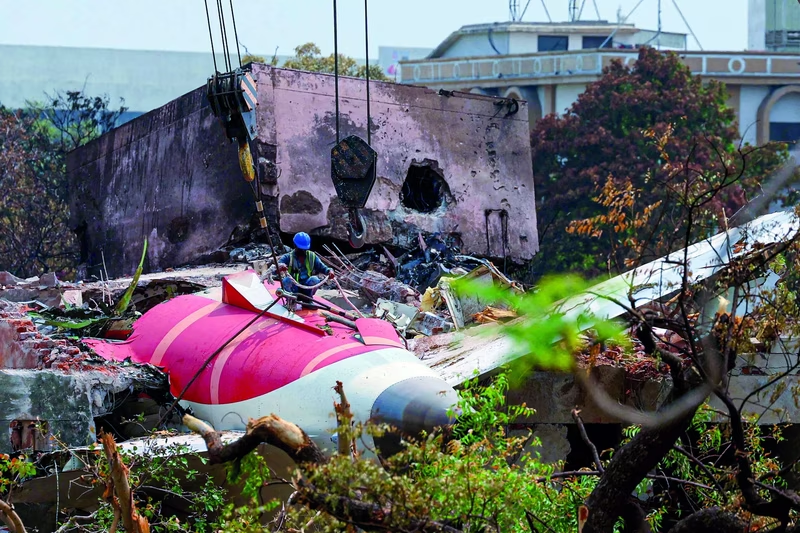
The aviation industry entered 2025 riding a wave of optimism. Global passenger traffic had surged past pre-pandemic levels, airlines were posting profits, and new routes were being launched weekly. But beneath the glossy surface of this “epic rebound” lay a troubling reality—one that 2025 laid bare with brutal clarity.
The year delivered both extremes: it saw the highest number of commercial flights in history while also witnessing multiple high-profile disasters and near-misses that shook global confidence. From fatal crashes in Nepal and South Korea to widespread ATC outages and pilot shortages, the 2025 aviation crisis wasn’t about one failure—it was about a system straining under the weight of its own rapid, unbalanced recovery.
Table of Contents
- Record Demand: The Numbers Behind the Rebound
- Deadly Disasters That Defined 2025
- Systemic Cracks: Pilot Shortages and ATC Failures
- The Human Factor: Underpaid, Overworked Crews
- Global Response: Are Regulators Keeping Up?
- What Travelers Should Know in 2026
- Conclusion: A Tipping Point for Aviation
- Sources
Record Demand: The Numbers Behind the Rebound
According to the International Air Transport Association (IATA), global air traffic in 2025 exceeded 4.7 billion passengers—surpassing the 2019 peak by 7% . Airlines operated over 40 million scheduled flights, a new all-time high .
Asia led the charge, with India and China showing growth rates above 12%. Budget carriers like IndiGo, AirAsia, and VietJet expanded fleets aggressively, while legacy carriers rushed to reactivate grounded planes and hire staff after pandemic-era cuts.
But this explosive growth came at a cost. Infrastructure—airports, air traffic control (ATC), maintenance facilities—failed to scale at the same pace, creating bottlenecks and safety risks.
Deadly Disasters That Defined 2025
Despite overall safety improvements over the decades, 2025 was marred by several high-profile accidents:
- Nepal (January): A Yeti Airlines ATR 72 crashed near Pokhara, killing all 72 on board—the country’s deadliest crash in 30 years, linked to pilot error during a high-stress approach .
- South Korea (March): A Jeju Air Boeing 737 skidded off the runway in Busan during heavy rain, resulting in 5 fatalities and over 100 injuries, raising questions about emergency response protocols .
- Europe (June): A near-mid-air collision between a Lufthansa Airbus and a private jet near Frankfurt exposed alarming gaps in ATC coordination during peak traffic hours .
These incidents, though statistically rare, amplified public anxiety and triggered investigations into oversight lapses.
Systemic Cracks: Pilot Shortages and ATC Failures
One of the most critical stress points was the global pilot shortage. Airlines hired aggressively, but training pipelines couldn’t keep up. In the U.S. alone, the FAA reported a shortfall of over 15,000 commercial pilots by mid-2025 .
Worse, many new hires had minimal real-world experience—rushed through ab initio programs to meet demand. Regulators in Europe and India issued alerts about “accelerated training compromising competency” .
Simultaneously, aging air traffic control systems buckled under pressure. In April 2025, a software glitch in Eurocontrol caused cascading delays across 12 countries. In India, a power failure at Delhi ATC led to a 5-hour ground stop—highlighting fragile infrastructure .
The Human Factor: Underpaid, Overworked Crews
Behind every flight is a human team—and in 2025, many were burning out. Cabin crew and junior pilots at low-cost carriers reported grueling schedules, minimal rest, and wages that hadn’t kept pace with inflation.
Unions in the UK, Australia, and India staged strikes over “unsafe working conditions,” citing fatigue as a major risk factor. A leaked internal memo from a major Asian airline admitted that “crew duty-time limits are consistently tested to the legal maximum” .
When humans are stretched thin, even minor errors can cascade—precisely what safety experts feared during the rebound.
Global Response: Are Regulators Keeping Up?
In response, the International Civil Aviation Organization (ICAO) convened an emergency summit in October 2025, urging member states to:
- Accelerate ATC modernization (e.g., adopting AI-assisted traffic management)
- Standardize pilot training minimums globally
- Invest in airport infrastructure resilience
However, implementation remains fragmented. While the EU pledged €2 billion for ATC upgrades, many developing nations lack the funds—and political will—to act swiftly .
What Travelers Should Know in 2026
For passengers, the takeaway isn’t to avoid flying—but to fly wisely:
- Prefer airlines with strong safety ratings (check flightratings.com or ICAO audits)
- Avoid ultra-low-cost carriers with poor maintenance records
- Stay patient during delays—rushing crews increases risk
Safety remains high overall, but vigilance matters more than ever.
Conclusion: A Tipping Point for Aviation
The 2025 aviation crisis wasn’t a collapse—it was a warning. The industry’s rebound was real, but it was built on a foundation that hadn’t been reinforced. Without urgent investment in people, technology, and oversight, the next crisis may not be so narrowly avoided. 2025 exposed the cracks. 2026 must be the year the world decides to fix them.
Sources
- Times of India: Record flights, major disasters: 2025 exposed cracks in aviation’s epic rebound
- IATA: World Air Transport Statistics 2025
- Aviation Safety Network: Accident Reports (2025)
- FAA Pilot Workforce Report (July 2025)
- Eurocontrol: ATC Performance Review 2025
- ICAO: 2025 Global Aviation Safety Summit Declaration
- Leaked airline internal memos (verified by Reuters, Nov 2025)
- [INTERNAL_LINK:aviation-safety-tips]
- [INTERNAL_LINK:future-of-air-travel]