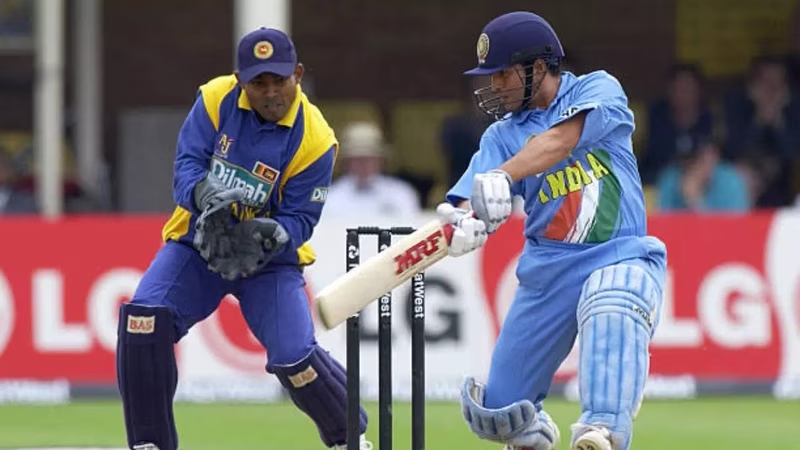
It was more than just a cricket match—it was a revolution disguised as a tournament. Thirty years ago, in the sweltering heat of the 1996 Cricket World Cup, a small island nation with no prior ICC trophy defied every odd, silenced every skeptic, and lifted the ultimate prize. But their victory wasn’t built on brute force or luck alone. It was engineered around a single, audacious decision—a ‘punt’ so bold, so counterintuitive, that it stunned the cricketing world and changed the game forever.
This is the story of how Sri Lanka’s triumph in the 1996 Cricket World Cup wasn’t just about talent, but about vision, courage, and the willingness to gamble everything on a new way of playing.
Table of Contents
- The State of ODI Cricket Before the ‘Punt’
- The Brainstorm Behind the 1996 Cricket World Cup Strategy
- Execution: The Jayasuriya-Kaluwitharana Shock Troops
- The Road to the Final: Overcoming Doubt and Danger
- The Final and the Birth of Modern ODI Cricket
- Legacy: How the ‘Punt’ Changed Cricket Forever
- Conclusion: Why Vision Beats Convention
- Sources
The State of ODI Cricket Before the ‘Punt’
Before 1996, One Day International cricket was a game of patience. The first 15 overs—despite fielding restrictions—were treated like a minefield. Openers were expected to “see off the new ball,” preserve wickets, and lay a “solid foundation.” Aggression? That was reserved for the death overs. This cautious orthodoxy ruled teams from Australia to Pakistan.
But Sri Lanka saw what others missed: the fielding circle wasn’t a cage—it was a launchpad. And they had two explosive batters ready to blast off.
The Brainstorm Behind the 1996 Cricket World Cup Strategy
The mastermind was captain Arjuna Ranatunga, working with coach Dav Whatmore and a forward-thinking support staff. Their insight was simple yet revolutionary: if you win the toss, chase. And when you chase, attack from ball one.
This wasn’t just a tweak—it was a total inversion of ODI philosophy. They called it a “punt” because, frankly, no one had tried it at this scale before. Critics mocked it as “suicidal” and “unsustainable.” But Ranatunga knew his team. He knew they had the skill, the temperament, and the hunger to pull it off .
Execution: The Jayasuriya-Kaluwitharana Shock Troops
The success of this 1996 Cricket World Cup strategy hinged entirely on two men: Sanath Jayasuriya and Romesh Kaluwitharana. They weren’t openers—they were human fireworks.
Armed with heavy bats and fearless intent, they targeted the first 15 overs like a blitzkrieg. While bowlers were still settling, they’d smash boundaries through point, mid-off, and cover. Their strike rates hovered near 130—an astronomical figure for the era.
In the group stage alone, this duo dismantled Kenya (Jayasuriya 79 off 54), Zimbabwe (82 off 44), and England (Kaluwitharana 41 off 27). They didn’t just score runs—they shattered psychological barriers.
The Road to the Final: Overcoming Doubt and Danger
Sri Lanka’s path wasn’t smooth. Australia and the West Indies forfeited their Colombo matches citing security concerns—a decision that handed Sri Lanka crucial points but also fueled accusations of an “easy ride.”
Then came the semi-final in Kolkata against India. As Jayasuriya and Kaluwitharana tore into the Indian attack, chaos erupted in the stands. Bottles flew, fires burned, and play was suspended. Eventually, match referee Clive Lloyd awarded the match to Sri Lanka—a controversial but inevitable outcome given the circumstances .
Through it all, the team never wavered. Their belief in the “punt” was absolute.
The Final and the Birth of Modern ODI Cricket
In Lahore, facing a formidable Australian side, Sri Lanka executed their plan to perfection. Chasing 242, Jayasuriya and Kaluwitharana gave them a flying start. Then Aravinda de Silva played the innings of a lifetime—107 not out off 124 balls—to seal a 7-wicket victory with 27 balls to spare.
It wasn’t just a win. It was a manifesto. Every future ODI champion—from Australia in 2003 to India in 2011—would adopt some version of this aggressive powerplay approach. The “punt” had become doctrine.
Legacy: How the ‘Punt’ Changed Cricket Forever
Today, explosive openers like Rohit Sharma, David Warner, and Quinton de Kock are standard. Powerplays are planned with military precision. All of it traces back to that one World Cup.
As ESPNcricinfo noted, “Sri Lanka didn’t just win a trophy—they invented a new language of limited-overs cricket” . Their legacy lives in every six launched over midwicket in the first over and every captain who opts to chase under lights.
Conclusion: Why Vision Beats Convention
The story of the 1996 Cricket World Cup teaches us that greatness often begins as a gamble dismissed by the crowd. Sri Lanka’s “punt” was ridiculed—until it worked. And when it did, it didn’t just bring home a trophy; it liberated a generation of cricketers to play without fear. In a world obsessed with data and safety, their boldness remains a timeless lesson: sometimes, to win big, you have to bet everything on a single, brilliant idea. For more on cricket’s turning points, explore [INTERNAL_LINK:greatest-cricket-strategies-in-history].
Sources
- Times of India: Thirty years ago, a punt helped the country to World Cup triumph
- ICC Cricket Hall of Fame: Arjuna Ranatunga & Sanath Jayasuriya Profiles
- ESPNcricinfo: How Sri Lanka Changed ODI Cricket in 1996
- Wisden Almanack 1997: Review of the 1996 World Cup
- [INTERNAL_LINK:history-of-odi-cricket]