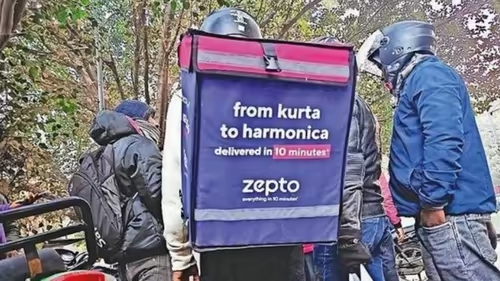
Remember the dizzying promise of groceries at your doorstep in just 10 minutes? It felt like magic—until the reality behind the curtain came into focus. In a landmark move, Indian authorities recently directed quick commerce platforms to ditch the ‘10-minute delivery’ tagline, citing concerns over worker safety and unrealistic expectations .
On paper, it’s progress. But on the ground? For riders like Sumit Singh—who recently climbed 17 floors on foot because he “couldn’t wait for the lift”—nothing has really changed. The branding may be gone, but the pressure is very much alive. And for thousands of gig workers across Delhi and other metros, their earnings still hinge on one brutal truth: the quicker you deliver, the more you earn.
Table of Contents
- The End of ’10-Minute Delivery’ Branding
- Why the Pressure Hasn’t Stopped
- Inside the Life of a Deliverer: Survival of the Quickest
- The Hidden Incentive Structure
- What Customers Don’t See
- Global Context: Are Other Countries Faring Better?
- Conclusion: Real Change Requires More Than a Name Change
- Sources
The End of ’10-Minute Delivery’ Branding
In late 2025, following mounting scrutiny from regulators and labor advocates, India’s Department of Consumer Affairs issued a clear directive: quick commerce companies must stop advertising “10-minute delivery” as a standard service promise . The rationale was sound—such claims not only set impossible benchmarks but also incentivized reckless behavior among delivery personnel, from speeding on bikes to skipping safety protocols.
Major players like Blinkit (formerly Grofers), Zepto, and Swiggy Instamart quickly complied, scrubbing the phrase from their apps and marketing materials. Officially, the era of hyperlocal ultra-fast delivery was over.
Why the Pressure Hasn’t Stopped
Yet, if you talk to riders on the street, they’ll tell you the game hasn’t changed—only the scoreboard has been hidden. The core business model of quick commerce still relies on speed as its primary differentiator. Even without the “10-minute” label, customers expect near-instant service. Platforms, in turn, reward riders who complete more orders per shift.
As Sumit Singh bluntly told reporters: “Only way to earn more is to be the quickest” . That single sentence cuts to the heart of the issue. The 10-minute delivery promise may be retired, but the operational DNA of these companies remains unchanged.
Inside the Life of a Deliverer: Survival of the Quickest
Imagine this: You’re assigned an order to a high-rise apartment. The elevator is slow—or broken. Waiting could mean missing your delivery window, getting penalized, or losing out on your next assignment. So what do you do? Like Sumit, you take the stairs. All 17 flights.
This isn’t an isolated incident. Riders routinely:
- Risk traffic fines by speeding through red lights
- Skip meals and bathroom breaks to stay on schedule
- Work 12+ hour shifts during peak seasons
- Face algorithmic penalties for delays beyond their control (e.g., traffic, building security)
Their income isn’t fixed—it’s directly tied to volume and speed. No wonder many describe their job as a daily marathon with no finish line.
The Hidden Incentive Structure
While platforms publicly tout “flexibility,” the reality is governed by opaque algorithms that prioritize efficiency over empathy. Riders report that:
- Top performers get priority access to high-value or easy-to-deliver orders.
- Consistently “slow” riders are deprioritized, leading to fewer assignments and lower earnings.
- Bonuses are tied to same-day completion rates, creating intense pressure to never say no—even in rain, heat, or illness.
This system creates a self-perpetuating cycle: to earn a living wage, riders must work faster; to work faster, they cut corners on safety. It’s a classic case of platform capitalism externalizing its costs onto its most vulnerable workforce.
What Customers Don’t See
When you tap “order now” on your phone, you see a countdown timer and a map with a moving dot. What you don’t see is the human behind that dot—exhausted, stressed, and racing against an invisible clock. A 2023 International Labour Organization (ILO) report highlighted that gig workers in emerging economies often lack basic social protections, including health insurance, paid leave, or injury compensation .
For more on the ethics of the digital gig economy, explore our analysis on [INTERNAL_LINK:gig-economy-worker-rights].
Global Context: Are Other Countries Faring Better?
India isn’t alone in grappling with this dilemma. In Spain, a 2021 law reclassified many gig delivery workers as employees, granting them minimum wage and benefits. The UK Supreme Court ruled in 2021 that Uber drivers are workers entitled to holiday pay and pensions . Even in the U.S., cities like Seattle have passed ordinances requiring platforms to provide paid sick leave.
These moves recognize a fundamental truth: when a company controls how, when, and where work is done, it bears responsibility for the worker’s well-being. India’s ban on “10-minute delivery” is a start—but without structural reforms, it’s merely cosmetic.
Conclusion: Real Change Requires More Than a Name Change
Dropping the “10-minute delivery” slogan was a necessary first step, but it’s far from sufficient. As long as the underlying incentive structures remain intact—and as long as customer expectations are shaped by years of ultra-fast promises—the pressure on delivery riders will persist. True reform requires transparent pay models, fair algorithmic oversight, and legal recognition of gig workers’ rights. Until then, for thousands like Sumit Singh, it will always be survival of the quickest.
Sources
[1] Times of India: Can’t wait for the lift: 10-min branding gone, but delivery gig is still survival of the quickest
[4] International Labour Organization (ILO): World Employment and Social Outlook – The role of digital labour platforms in transforming the world of work
[5] UK Supreme Court: Uber BV v Aslam [2021] UKSC 5
[6] Ministry of Consumer Affairs, Government of India: Advisory on Misleading Advertisements by Quick Commerce Companies