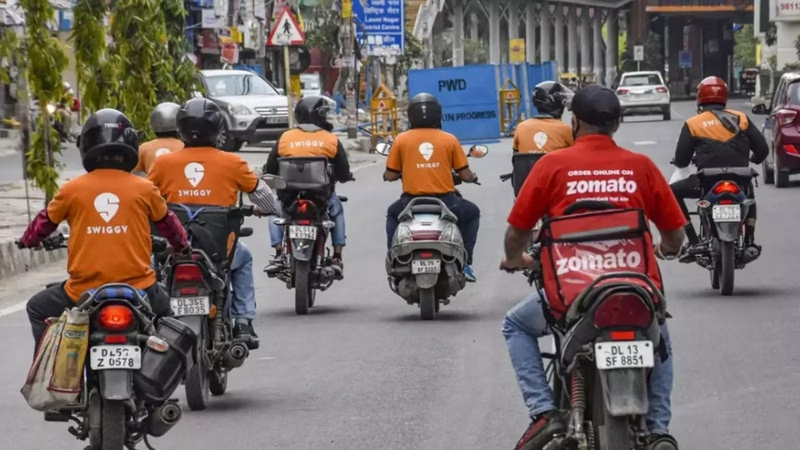
For years, the promise of groceries at your doorstep in just 10 minutes was the ultimate sales pitch for India’s booming quick commerce sector. But that race against the clock came at a hidden, human cost—until now. In a decisive intervention, the Union Government has effectively ended the era of the 10-minute delivery ban, forcing major players like Blinkit to scrub the controversial promise from their branding and operations.
The move, spearheaded by Union Minister for Health and Family Welfare, Mansukh Mandaviya, is a direct response to growing outcry over the dangerous working conditions faced by thousands of gig workers who were pressured to meet impossible time targets . This isn’t just a policy tweak; it’s a fundamental shift in how India balances consumer convenience with worker welfare in the digital age.
Table of Contents
- What Is the 10-Minute Delivery Ban?
- Why Did the Government Step In?
- How Are Quick Commerce Companies Responding?
- The Harsh Reality for Gig Delivery Partners
- How India’s Move Compares Globally
- What’s Next for the Quick Commerce Industry?
- Conclusion: A Win for Human Dignity Over Speed
- Sources
What Is the 10-Minute Delivery Ban?
The so-called 10-minute delivery ban isn’t a formal piece of legislation (yet), but rather a binding agreement between the Ministry of Health and key quick commerce companies. Following a high-level meeting, these firms—including market leaders like Blinkit (owned by Zomato) and Zepto—have assured the government they will immediately cease advertising or enforcing any strict 10-minute delivery timeframes .
Blinkit has already taken concrete action, removing all references to “10-minute delivery” from its app interface, marketing materials, and social media channels . This marks a significant retreat from the core promise that fueled their hyperlocal, “dark store” business model.
Why Did the Government Step In?
Minister Mansukh Mandaviya’s intervention was driven by alarming reports of gig workers suffering severe injuries, exhaustion, and even fatalities while trying to meet these aggressive deadlines . The pressure to deliver within 10 minutes often forced riders to break traffic laws, skip safety gear, and work excessively long shifts without adequate rest.
The government framed this as a public health and safety issue, arguing that the relentless pursuit of speed was creating a dangerous precedent where human life was secondary to corporate metrics. This stance aligns with a broader global conversation about the ethics of the gig economy, which has been scrutinized by organizations like the International Labour Organization (ILO) for its lack of worker protections .
How Are Quick Commerce Companies Responding?
The industry’s response has been swift and compliant. Beyond Blinkit’s rebranding, other major players have issued statements committing to “responsible delivery practices.” While they haven’t abandoned their core promise of ultra-fast service, they are now shifting their messaging to emphasize “as fast as possible” or “within 15-20 minutes,” a subtle but crucial change.
This pivot also reflects a strategic calculation. With regulatory scrutiny intensifying and public opinion turning against exploitative practices, companies see cooperation as essential for their long-term survival in the Indian market. For more on the evolving regulatory landscape for tech startups, see our guide on [INTERNAL_LINK:india_tech_regulations].
The Harsh Reality for Gig Delivery Partners
Behind the convenience of a 10-minute delivery was a grueling reality for the workers making it happen:
- Unsafe Driving: Riders reported being penalized for late deliveries, leading to reckless speeding and ignoring traffic signals.
- Financial Pressure: Their earnings were directly tied to the number of deliveries completed, creating an incentive to take dangerous risks.
- Lack of Benefits: As independent contractors, they had no access to health insurance, paid leave, or accident compensation.
- Mental Stress: The constant pressure and algorithmic monitoring led to high levels of anxiety and burnout.
The government’s move is a first step toward acknowledging these systemic issues and holding platforms accountable for the well-being of their workforce.
How India’s Move Compares Globally
India is not alone in grappling with this issue. In Europe, countries like Spain and France have passed laws reclassifying gig workers as employees, granting them full labor rights. The UK Supreme Court ruled that Uber drivers are entitled to minimum wage and holiday pay.
However, India’s approach is unique in that it directly targeted the root cause—the unrealistic time promise itself—rather than just the employment status. This proactive measure could serve as a model for other emerging markets facing similar challenges with rapid tech-driven growth.
What’s Next for the Quick Commerce Industry?
The end of the 10-minute promise doesn’t spell doom for quick commerce. Instead, it forces a necessary maturation of the business model. Companies will likely focus on:
- Optimizing their dark store network for efficiency, not just speed.
- Investing in better rider training and safety equipment.
- Developing fairer incentive structures that don’t punish unavoidable delays.
- Building customer loyalty through product quality and reliability, not just delivery time.
The industry’s future success will depend on its ability to prove that convenience and compassion can coexist.
Conclusion: A Win for Human Dignity Over Speed
The 10-minute delivery ban is a watershed moment for India’s digital economy. It sends a clear message that technological innovation cannot come at the expense of basic human safety and dignity. By prioritizing the lives of gig workers over a marketing gimmick, the government has set a powerful precedent that could reshape not just quick commerce, but the entire gig economy landscape in the country. The real test now is whether this commitment translates into sustained, enforceable protections for the invisible workforce that powers our on-demand world.
Sources
- “Gig workers row: No more 10-minute delivery deadline; Centre urges quick commerce players to drop time limit”, Times of India, January 2026.
- Blinkit removes ’10-minute delivery’ promise from its app and marketing, Economic Times.
- Union Minister Mansukh Mandaviya cites safety concerns for gig workers in official statement, PIB.
- International Labour Organization (ILO) report on platform work and worker protections, ilo.org.